Saturday, August 22, 2026

How do bees know where to go?

I stumbled across a couple of related articles on Phys.org. I was directed there via Google's news page. It is well established that a successful forager bee will communicate the location of a nectar source to other forager bees via the famed waggle dance, in which the vector location (distance and direction) of the source from the hive is specified by the angle and frequency of the waggle.
Bees watching a waggle dance.
Waggle Dance

It turns out that foragers who have been out and about will also cross check that information with their own knowledge of the terrain.  If the dance location includes landmarks a follower bee is already familiar with, the bee will use those landmarks to hone in on the nectar source, rather than just flying blindly in the indicated direction. (Phys.org Bee Communication)
There should be a tree near that location, so I will fly to the tree first, then I will look for the flowers.
rather than
There's the sun.  I go this direction....  That should be about the right distance.... Where are the blooms?

Additionally, once the bee has found the nectar source, it flies it's own specific path from the hive to the source and back with surprising regularity and accuracy! (Phys.org Bee Flight Path)

Efficient little...ahem...buggers.

While we're here, we have one new somewhat smaller extraction. (The bees had only capped about 80% of the frames so we only extracted the frames that were capped.) It's very mild in flavor and just semi-sweet. But it does have a slight pumpkin-spicy quality. Come try it.

Tuesday, July 14, 2026

Books!

We came home yesterday to find these books propped up in front of the honor stand.
The way of the Hive by Jay Hosler and Sue Unstead's Amazing Bees
Bee Books by the Stand

What a kind gesture! We have no idea who left them. If it was you and you see this post, thank you. You made our day.  I'm particularly interested in reading the graphic novel that Neil Gaiman called wonderful.

Sunday, July 12, 2026

Two new batches!

We were away for a few weeks, but now we're back. We saw that there was one super that was about 75% capped when we left so we knew we wanted to check on it soon after returning. What we didn't expect was the next super on top of that was also going to be full and capped.
So, this past weekend we harvested and extracted two supers of honey: Early summer (late June) and Summer (July). We may find we have a late July harvest as well...but that remains to be seen.
The early summer super definitely has a fruit quality.  I think it is apple/pear related. My husband gets vestiges of citrus blossom and stone fruit. Regardless,  it's sweet but not jam like.  The fruit is definitely crisp and bright.
The second super a few weeks later is definitely summer flowers and darker fruit notes. Jasmine, lavender and blackberry blossoms with a sense of allspice on the finish (thistle?)
I've got jars on order, but a few jars of the early summer are available now. The rest should be out by end of week.

Wednesday, June 17, 2026

We now have April and June 2026 extractions

We were able to harvest and extract another 2.25 gallons of honey and extract it last weekend.  We have it bottled and newly available in our stand. This super seemed to have even more of the citrus and mockorange nectar in it providing a very sweet floral bouquet to highlight a fresh and mildly sweet flavor. Less herbal than the April extraction, but still with a slight green bitter finish -- like lime zest?
Come try it for yourself.

Saturday, May 9, 2026

It took some time, but we've harvested

Only the first super so far.  We added a third recently. They have drawn out comb in that super and there's plenty of nectar in it. The second super we added near the end of March is full, but not yet completely capped, so we're leaving it for another week or so.
We went ahead and extracted right away while we have some time, and should have some honey bottled soon! Yum.


Sunday, March 29, 2026

Exactly four weeks later

...we checked to see how the first super was being filled. We are surprised to learn that it is already completely full and capped. We have added a second super with comb already drawn from last year. We left the full super on because we are not prepared to do an extraction any time soon (maybe next week) and the bees will keep the honey from pests for us in the mean time. It will also hopefully lead the bees to start filling the new super.
Short story is: we should have honey available before May...(fingers crossed).
Last Week

Today
We want the hive to have a start filling the new super, find time to extract, prepare jars, bottle and label, get the stand out again....

Saturday, February 28, 2026

Spring is springing

With the mild winter and a relatively warm past couple of weeks, the bees have become rather active.  We noticed that there were some vigorous orientation flights happening, but with a still present threat of cooler days and some rain, we were reluctant to remove the entrance reduction we had put in place.  (I couldn't find our official entrance reducer, so I just propped a stick across part of the entrance, and that has been working fine.)
However a few days ago we saw a stream of bees backed up on the hive front as they tried to return from their orientation flight. 

I pried up the hive cover a little and saw that the population appears robust. The threat of rain has passed, and the temperatures seem to be past risk of dropping below the 60s during the day, so we decided it was time to give the colony some more room to expand their storage and keep them from feeling crowded and prone to swarm.  Today we added a honey super with some new foundation. (The old comb we kept had a little moth damage, so we are going to treat them with sunshine and then freeze them to eliminate any eggs and larvae before introducing it into the hive again.)


We dusted both of the hive bodies with powdered sugar, just as a preventative measure to help the bees knock any mites off of themselves to try and keep them at bay.  This colony is hyper-hygienic, and while mites are a persistent problem, the bees have kept them in check pretty well last year.
The hive bodies are pretty full, except the end frames. Hopefully that bodes well for a strong start to the year and a plentiful harvest.

Saturday, January 10, 2026

Thank you! Happy New Year.

We are all sold out for the year.  Many thanks to everyone who was able to stop by our little stand and take home a sample of the Princesses' work.  They will have more for us to put out in the Summer.

There are still stirrings when the weather is warmer, so we anticipate a pretty easy time for them to re-establish in March.  Until then, have a wonderful new year.

Wednesday, December 24, 2025

Farewell to the old year and welcome back to the new light.

The bees are still cozy in the hive.  On warmer days, several still venture out to forage what they can.

Beginning this week, the days gradually become longer (mornings will come earlier to begin, and gradually the evenings will last later).

So while the cold days are still ahead of us, we recognize the promise that spring will return.

The trees and flowers will bloom again, nectar will flow again, and there will be more honey to harvest.

For now, though we are down to our last two jars to sell in our little stand.

We are grateful to everyone who has purchased a jar or two from us, and sincerely hope that our bees' efforts have brought a little pleasure to everyone who has stopped by.

When these last jars are gone the stand will be closed until early Summer, 2026, when we anticipate we will be able to begin extracting the new year's supply.

Until then, stay safe and warm and enjoy the joys the season has to offer.

Good Yule. Happy Holidays. Have a wonderful New Year.

With joy and gratitude from the Pollen Princesses.


Saturday, November 8, 2025

Holidays are upon us.

Honey production is over for the season.  The bees are still out foraging while the weather is warmish, but we've removed the honey supers and what they are collecting will provide for them and allow them to keep their own stores of honey until it is cold enough that they are forced to remain in the hive, clustering to keep warm and protect the queen.  Then, they will depend on their honey stores for sustenance until spring.

Because they seem to have less problems with invasive pests this year, they should have a good head start when spring arrives because they won't have to repair the wax comb as much or do as much cleaning. Once they can forage for nectar, that can go directly to honey production rather than wax production.

We will also be hunkering down for the rainy season and relying on our own canning for the winter, keeping soul and sprit warm by celebrating the holidays: Thanksgiving, Solstice, Hanukkah, Christmas, New Year.... reminding ourselves that the blossoms will return in time.


One of my very favorite holiday traditions is fruitcake.  Mock it all you wish, but a good fruitcake--well spiced; with dried apricot, figs, dates, candied citron and cherries mingled with hazelnuts, walnuts and/or almonds; rum soaked and aged slightly to allow the flavors to develop--is a delight. Italy has their own take on fruitcake, from Siena: a dried fruit, nut tart robustly spiced with ginger, clove, cinnamon, allspice, nutmeg, coriander and a little black pepper, and of course, honey--named panforte, "strong bread".

It starts with honey and sugar, boiled gently together until they reach a soft-ball stage.  This syrup is poured over a mix of dried and candied fruits, citron, cherries, and maybe some candied ginger, blanched almonds and hazelnuts that have been dusted with all the dried spices, a little flour, and just enough cocoa powder to add a rich depth to the flavors.

The mixture is pressed into a round pan and baked at a medium temperature for 20 minutes to bring everything together into a nougat-like consistency. The flour merely helps everything adhere and prevents the caramel from becoming too sticky.  If you are gluten sensitive, any gluten free blend works just as well since the flour doesn't provide the structure.

There are multitudes of recipes out there, but once you have the basic proportions of nut, fruit, and honey syrup to flour, you can use whatever fruit and nuts make you the most happy and spice it up to your heart's content -- lemon zest? cardamom? a little chile? more cocoa? Dust with generous confectioners sugar and let the celebrations commence.

Monday, October 20, 2025

Winterizing

Now that we have extracted the final super of honey from the hive for the year, it's time to consider setting up the hive for success in overwintering.  We have had less of a mite problem this year, thanks in no small part to investing a few more dollars in a mite-resistant queen.  This colony has consequently been VERY fastidious about hygiene, sealing off everything that could be a potential entrance for pests with propolis, and disposing of debris (and infested brood) diligently.
Last year, I think the mites reached a level where they compromised the strength of the hive and we lost to colony to a host of pests including wax moths and hive beetles.
There is evidence this year of wax moths trying to make their presence felt, and we've seen several hive beetles scurrying around, but--from what information we can find--so long as the colony isn't being overwhelmed by mites, they should be able to keep the beetles and moths at bay.
However, we want to make sure the hive cover is well sealed, reduce the front entrance opening and we'll probably want to put the hive bodies on a solid bottom board in place of the screened bottom board we have now.  That will minimize the ability of pests to enter, and interrupt the reproduction of the hive beetles (whose larvae leave the hive to mature in the ground under the hive and then climb back inside).
The bees are still pretty active right now, but shortly after Halloween we'll make one last check, dust with powdered sugar to help disperse any stray mites and minimize entrances.
In the temperate climate here in Sacramento, the bees won't have to expend too much energy keeping warm, and will still be able to get out and forage on the nicer days, so I have high hopes that they will weather this winter better than last year's colony.

Sunday, October 5, 2025

New, and final extraction of the year

Last weekend we were able to get into the hive and remove the last honey super for the year.  This involves removing each frame of honey one by one, brushing the bees off and back into the hive and removing the frame to a new box away from the bees.
Brushing bees from a frame of honey to be extracted.

We were able to extract the honey this weekend, and ended up with just exactly 2.5 gallons, 30lbs.  This batch is really fun.  Very dark in color, it's moderately sweet with a somewhat bitter finish -- very autumnal.  What makes it exciting though is it has a cedar-y sort of nose and a decidedly toffee (coffee?) taste with woodsy notes.
Wax comb emptied of the honey.
We have let it filter through a paint bag (bought fresh for this purpose) to remove the bits of wax that inevitably end up in the centrifugal extractor.  And will put it in jars soon, so look for it in our little stand sometime in the next week or so. Then you can try it for yourself.

Saturday, October 4, 2025

New bees are still orienting themselves

We're about ready to extract the final super of the year.  I'll post that once we have started.  We have removed the super, but have not had time to take care of the frames much so we wrapped them to protect them from wax moths and hope to start extracting this afternoon or tomorrow.    

Meanwhile, I captured this pretty dramatic orientation flight.
One can tell that it is an orientation flight by watching the bees circling in figure-8 type patterns around the entrance.  They are checking for landmarks to ensure that once they venture out foraging, they will be able to recognize the way home.

Saturday, September 13, 2025

Updating Some Branding

Since we are in a new town and new neighborhood, of course we want to label our honey appropriately.  I had just decided that I would keep our original logo and font for the jar labels, and simply change the text to the East Sacramento origin of the nectar.

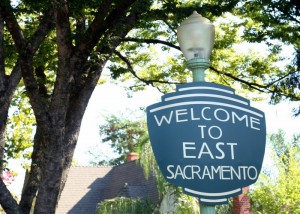
However, it occurred to me (if a bit late) that East Sacramento actually has its own branding from 2009.  The McKinley East Sacramento Neighborhood Association and the East Sacramento Improvement Association joined forces with the East Sacramento Chamber of Commerce and commissioned 7 Welcome to East Sacramento Signs.
From the East Sacramento Community Assn.

The outline and frame of the signs echoes the shape of the East Lawn Cemetery clock.
Eastlawn Clock, SacramentoRevealed.com

It has since become popular for homes to display replicas of the signs in yard or on house-fronts.
A little searching for a decent imitation of the typeface and adapting the scale to fit a label and I present:


What do you think?

We'll keep the original for the shop branding, but this will go on the local honey jars.

Monday, September 1, 2025

Orientation

Bees spend the first few weeks after emerging from the brood cells working inside the hive caring for other brood, managing the food supply, guarding the entrance from intruders, cleaning.  After about three weeks the venture into the outside world and become foragers.
In the days leading up to this change in responsibility, they begin making forays outside: orientation flights around the hive and surroundings, so they can recognize home and the landmarks that will lead them back. For whatever reason, the bees often choose to do this activity in the mid-late afternoon, all at the same time. This can often look like the bees are planning to swarm, as I thought a few days ago.  There was a particularly large orientation flight happening, and bees began clustering on the front of the hive, not normal bearding to keep cool, but clumping in the middle of the top hive body.  The airborne bees were making the distinctive 8-shaped patterns of an orientation flight, though; and sure enough--within about 5 minutes of me convincing my partner we needed to try and capture the swarm--the bees began to flood back down and into the hive entrance. 
While the prospective foragers are exploring, some of their sisters will gather outside the entrance and fan the hive scent outward with their wings, nature's air traffic control signaling the path to the runway.


Sunday, August 24, 2025

New extraction today

Last week, we were able to remove one of the two supers from the hive.  The other super (put on about two weeks ago, when the existing super was about 85% full) has most of the wax drawn out by the bees, but they have only just started adding nectar to the cells so it might be another two to three weeks before we will consider adding another super, or just letting them fill that second super and leave them to prepare for autumn.
It is a not too sweet and rather dark honey, much darker than our first extractions last year.  Sadly, we had a little wax moth damage in part of one frame so we didn't extract that frame.  We set it in the freezer to kill any remaining wax moth remnants and will return the frame to the hive for the bees to clean out, along with the empty comb.
We're filtering the resulting 2 gallons of honey as we speak (type...read...?) and will be ready to put in in jars by this coming weekend, so then we will have 6 variations on offer in our little stand.  Though we are down to less than half a gallon of two of those variations.
[The little stand has received a few visitors already.  Thank you if you were one of them.  We're working on getting some signs up to direct traffic our way, and maybe a few little jars with samples and some coffee stirrers for tasting...?]

Saturday, August 23, 2025

And we're stocked!

We have our honor stand up and available!

Stand stocked and ready to sell

Come get some to take home yourself!

Sunday, August 17, 2025

Almost Ready to Sell Again

This weekend we were able to remove a super for extraction.  We have another super on top, but it did not have comb built out, so the bees had to take the time to draw the wax and it has very little honey added to it yet.
The weekend also sees us almost ready to start selling our honey again.
I ordered new jars a few weeks ago, and we filled them and labelled them.
We have just about finished a little cabinet where we can put the jars for sale near our sidewalk.
I've made a little poster/price list with a QR code to accept payments, and there is a cash slot in the cabinet as well.
The honor system honey cabinet

I've printed up the descriptions of each harvest to hang on the shelves by the jars.
The cabinet still needs a couple shelves, and I should find a way to put a little color code sticker on the jars to distinguish the different harvests.
I have sold ~15 jars to staff at school already, but now we can reach more of the local residents.
I'll put up a new post once we have the stand set up and ready.
Find us in East Sacramento.


Friday, August 8, 2025

Grape Harvest

In non-bee news, we just harvested our syrah grapes.
Syrah bunch going into the colander
When first we moved into our home in East Sacramento, a good friend was helping us move some furniture with her truck.  She looked at out porch and said: that's going to get hot in afternoons; you should put a grape vine on the corner to shade it.
She was very right.  The porch did get hot in the summer and the grape vine has provided enough shade to make a marked difference.
Veraison last year
Next stop: attempted rosé of syrah.

Sunday, August 3, 2025

New Bottling - Updated

New jars arrived.  I have dug up the old labelling materials.  Spent a little time this morning bottling some of the honey that we harvested last year.  There is one more batch of honey from the year prior that can be bottled, once we have warmed it slightly; it has crystallized in the intervening year and I want to gently re-liquify it. [Update -- I have bottled a few jars of this now too!]

I've updated the labels to reflect our new location.
The artists and their work.

We have four different harvests from last year ready to go: 
top: Spring 2024
bottom left to right: early and mid-summer, and early fall
Summer 2023
This light amber honey, harvested in 2023 from our East Sacramento garden, is bursting with the taste of summer. It has a beautiful fruity essence, evoking notes of stonefruit (almond, peach and apricot). The finish is a beautiful combination of a soft, floral undertone and a unique marshmallow-like sweetness. (not pictured)

Late spring 
A delicate and light amber honey harvested from the early spring blossoms of East Sacramento. Bees forage on blooming early almond,  fruit trees and local wildflowers, creating a mild, floral flavor with subtle notes of almond blossoms subtle herbs and a nice floral finish.

Early summer
Crafted from the rich, summer bloom of East Sacramento, this honey is a bolder expression of the season. Our bees collect nectar from hearty plants like sages, mock orange, and lavender, giving the honey a distinct golden color and a complex, aromatic sweetness with distinct herbal notes and amazing orange blossom inspired finish. 

Mid summer
A robust, deep amber honey harvested from East Sacramento's mid-summer bloom. Bees forage on late-season wildflowers and tenacious urban flora like star thistle, sunflower and summer herbs like basil, oregano and thyme. The result is a viscous, crystalline, honey with a complex, herbal and earthy sweetness with a somewhat bitter finish.

Fall
A silky, deep amber honey, capturing the last blooms of an East Sacramento fall. Bees forage on late-season flowers like allium, goldenrod and herbs. The result brings a lovely clean sweetness with light hints of clay and spice. 

Now for marketing. I am disenchanted with Etsy, where we used to sell, and we don't have a relationship with any local market yet like we did with Bi-Rite in San Francisco. I am half-tempted to just create a little honor-system stand in the front yard with a little cash box, or a QR code to my square....

I have only bottled less than half so far; I want to see what sizes sell in which harvest before I commit all of the jars.  I'd rather sell out of a particular harvest than have to backorder while I get more jars.