Now that we have extracted the final super of honey from the hive for the year, it's time to consider setting up the hive for success in overwintering. We have had less of a mite problem this year, thanks in no small part to investing a few more dollars in a mite-resistant queen. This colony has consequently been VERY fastidious about hygiene, sealing off everything that could be a potential entrance for pests with propolis, and disposing of debris (and infested brood) diligently.
Last year, I think the mites reached a level where they compromised the strength of the hive and we lost to colony to a host of pests including wax moths and hive beetles.
There is evidence this year of wax moths trying to make their presence felt, and we've seen several hive beetles scurrying around, but--from what information we can find--so long as the colony isn't being overwhelmed by mites, they should be able to keep the beetles and moths at bay.
However, we want to make sure the hive cover is well sealed, reduce the front entrance opening and we'll probably want to put the hive bodies on a solid bottom board in place of the screened bottom board we have now. That will minimize the ability of pests to enter, and interrupt the reproduction of the hive beetles (whose larvae leave the hive to mature in the ground under the hive and then climb back inside).
The bees are still pretty active right now, but shortly after Halloween we'll make one last check, dust with powdered sugar to help disperse any stray mites and minimize entrances.
In the temperate climate here in Sacramento, the bees won't have to expend too much energy keeping warm, and will still be able to get out and forage on the nicer days, so I have high hopes that they will weather this winter better than last year's colony.
Showing posts with label queen bee. Show all posts
Showing posts with label queen bee. Show all posts
Monday, October 20, 2025
Winterizing


Thursday, July 31, 2025
Trying to get back in the routine
It has been a decade since we have had the capacity to keep bees in the City. However, in 2021 we took advantage of the housing sales slump to relocate to Sacramento. Having our own house with our own yard means we get to have our own hives again and so we have started beekeeping once more.
 Last summer (with our nephew's help), we were able to extract a little over 12 gallons of honey. We like to extract the supers individually to get the character of the nectar as the season progresses.

The earlier extractions were very light in color and fragrantly sweet. The later season supers were substantially darker in color, but somewhat less viscous, less sweet and much more herbal in character. I've ordered a batch of jars and updated our labels so hopefully we will be ready to sell again in the very near future.
Over the intervening decade, it has become more challenging to maintain a healthy hive; the increase in types and tenacity of various parasitic pests in the hive means that the colony is now contending with hive beetles and wax moths while still battling mites. The mites are now spreading deformed wing virus which adds a new layer of challenge.
But at the same time, mite treatments are more varied with simple things to keep the mite population down such as managing drone brood and periodic dusting with sugar coupled with more aggressive miticide treatments when mite counts start to rise.
Keeping the mites at bay allows the bees to focus on keeping the other pests at bay and gives them a decent chance at survival.
This year we replaced our queen with a new variety that shows promise in mite resistance (Olivarez Golden West). So far, it seems to be working, I have seen very few mites on our bottom board and though there have been a few beetle sightings, there doesn't seem to be significant interference from them in the hive activity.


The earlier extractions were very light in color and fragrantly sweet. The later season supers were substantially darker in color, but somewhat less viscous, less sweet and much more herbal in character. I've ordered a batch of jars and updated our labels so hopefully we will be ready to sell again in the very near future.
For this year, we have one super nearing 80% capped. We added a second super recently and the colony population seems very robust. I anticipate at least 5 gallons of harvest by the autumn.
Sunday, September 4, 2011
Finally
It has been another roughish year for the bees, though not so bad as last year. We only had one colony really do well this year, and it currently seems to be struggling -- there does not seem to be any sign of a queen after a late swarm. We were able to capture a different swarm and start a new colony, hopefully it will be able to get itself up and running before the weather turns too cold and wet.
The good news is that the one hive that has been doing well for most of the summer has produced about 30 lbs. of honey for us so we will be able to get a small shipment to Bi-Rite for the fall and hopefully for the holidays as well. We are just working on getting it into jars and labeled now, so look for it in less than a week.
Please visit our shop to purchase Noe Valley Honey and other hive products from the Pollen Princesses.
The good news is that the one hive that has been doing well for most of the summer has produced about 30 lbs. of honey for us so we will be able to get a small shipment to Bi-Rite for the fall and hopefully for the holidays as well. We are just working on getting it into jars and labeled now, so look for it in less than a week.
Please visit our shop to purchase Noe Valley Honey and other hive products from the Pollen Princesses.
Friday, April 9, 2010
Gearing Up

About a month ago, we made the rounds of our hives to see how everyone had fared through the winter. At each location, interestingly enough, we found one strong hive that was already building a strong population and one hive that was nearly dead (if not completely dead). I don't believe that either of the dead hives was caused by colony collapse -- the bees did not just disappear from either one, that I can tell. Each of them had a colony that was a bit on the small side at the end of the fall, and I just don't believe they had a critical mass of population to maintain themselves through the winter.
At any rate, rather than ordering new packages for these two hives, we decided to do a split from the healthy hives at each location. We chose 5 frames from each healthy hive that were heavy with developing brood and eggs, and swapped them out with five empty frames from the empty hives. The hope was that the while the brood on these frames was hatching to maintain the population, the bees would raise one of the eggs as a new queen.
Yesterday and today, I made the rounds again and checked both locations -- in each location the strong hives were ready for their first honey super (yeay!). In fact at the Dolores Park location, it appeared that the colony was preparing swarm cells. I am pretty confident that I was able to get them a new super in time, but they were quite ready for more space.
What I really was anxious to learn though was whether the two weak hives were able to produce a new queen and whether she was successful in mating. At Dolores Park, I examined just a few frames before I found copious amounts of eggs in the cells! Some of the cells on one frame side seemed to have some strange laying patterns, such as more than one egg in a cell, or eggs attached to the side, rather than the bottom of the cell, but they overall laying pattern was good on the rest of the frames I examined, so I imagine that the one frame was just from the queen's early attempts as she first started laying.


At the other location the weak hive seemed to have a decent sized population, all things considered. However as I started examining the frames I could not find any eggs at all; frame after frame and all I found were adult bees. I was just about to close up the hive and run home to order a queen to give the hive, when I saw this!

Voilà la Reine! She appears to be plump enough that I believe she has mated already, she must not have started laying quite yet though. We'll give this hive a little more time and check again, but I think they are going to be alright.

Please visit our shop to purchase Noe Valley Honey and other hive products from the Pollen Princesses.
Monday, April 5, 2010
Heater Bees
It has long been recognized how well bees can maintain the temperature of their hive. By shivering to warm the hive or bringing in water and using their wings to evaporate it to cool.
Now researchers in Germany have determined how precisely temperature plays a role in the hive and specifically in the development of the bees' larvae.
Fascinating!
Read the article in the Telegraph here.
Please visit our shop to purchase Noe Valley Honey and other hive products from the Pollen Princesses.
Now researchers in Germany have determined how precisely temperature plays a role in the hive and specifically in the development of the bees' larvae.
Fascinating!
Read the article in the Telegraph here.
Please visit our shop to purchase Noe Valley Honey and other hive products from the Pollen Princesses.
Monday, July 20, 2009
The Queen was Where?
Strange goings on in one of the hives at the Dolores Park location.
We checked on four of the five hives in a little whirlwind yesterday. Most of them are super busy which is great news. The one slow one in the original location is still slow, but seems much healthier than before -- there is a lot of brood ready to hatch, and the queen is laying nicely. They probably just need a bit more time.

The first hive by Dolores Park though was very interesting. Last time I checked them a few weeks ago, they had filled the top hive body with brood and honey, so I put on a queen excluder and added a honey super. The super even has its own entrance which is supposed to encourage the bees to bring in more nectar since they don't have to travel through the excluder to get to the super.
When we opened the hive, there were no bees in the super -- they hadn't touched the frames, not even to build any wax. But Deno sharply spotted the queen wandering around on top of the excluder! When we examined the frames in the upper hive body, we found it filled to the brim, and we counted eight hatched queen cells, but no new queen cells.
Our best guess is that perhaps the hive swarmed and the new queen took her mating flight, but returned to the wrong hive entrance and went into the honey super entrance instead of the main entrance.
We made sure the queen was moved down into the top hive body, and reversed the hive bodies to put the relatively more open hive body on top. Replaced the queen excluder and are now hoping that the queen starts laying.
Please visit our shop to purchase Noe Valley Honey and other hive products from the Pollen Princesses.
We checked on four of the five hives in a little whirlwind yesterday. Most of them are super busy which is great news. The one slow one in the original location is still slow, but seems much healthier than before -- there is a lot of brood ready to hatch, and the queen is laying nicely. They probably just need a bit more time.

The first hive by Dolores Park though was very interesting. Last time I checked them a few weeks ago, they had filled the top hive body with brood and honey, so I put on a queen excluder and added a honey super. The super even has its own entrance which is supposed to encourage the bees to bring in more nectar since they don't have to travel through the excluder to get to the super.
When we opened the hive, there were no bees in the super -- they hadn't touched the frames, not even to build any wax. But Deno sharply spotted the queen wandering around on top of the excluder! When we examined the frames in the upper hive body, we found it filled to the brim, and we counted eight hatched queen cells, but no new queen cells.
Our best guess is that perhaps the hive swarmed and the new queen took her mating flight, but returned to the wrong hive entrance and went into the honey super entrance instead of the main entrance.
We made sure the queen was moved down into the top hive body, and reversed the hive bodies to put the relatively more open hive body on top. Replaced the queen excluder and are now hoping that the queen starts laying.
Please visit our shop to purchase Noe Valley Honey and other hive products from the Pollen Princesses.
Tuesday, June 2, 2009
Waiting

It has been kind of a slow start for the bees this year. I'm not sure why. We have had to replace one queen already (need to check her this Thursday to make sure she's out). Other hives are developing but slowly. We have put supers on three of the five hives now, though, and will add one to a fourth soon.

Meanwhile all the hives appear to remain healthy if not extremely populous yet. Most importantly, the mite issue with hive #1 seems to be under control. Powdered sugar is the cure -- completely safe and organic, yet effective!

Please visit our shop to purchase Noe Valley Honey and other hive products from the Pollen Princesses.
Sunday, May 3, 2009
Bees and Flowers Circadian Rythms
Here is an article in the New York Times about how bees and flowers coordinate their schedules to maximize the pollination/nectar trade.
We just went Friday to see our new hives and make sure that all is well with them. The two packages are each doing great. The Noe Valley one has eggs and the Dolores Park location hive has larvae already.
The swarm with the new queen on our friends roof is off to a very slow start -- the queen had not been released when we checked on her on Wednesday so we let her out of the cage. There were not many bees left in the hive, so we are hoping that the queen can start laying quickly.
The first hive that we had at the Dolores location is very busy. We put an empty deep full of frames on top of it to give them more room, but we might want to take a frame of brood out of it and move it to the rooftop hive.
Finally the initial hive in the first location seems quite sluggish. The colony is small and while I saw very young brood indicating that the queen was present within the past few days, I didn't see any eggs (though that might just be that I didn't look in the right cells), and the quantity of brood is very small. There is one sealed supersedure cell in the hive so it is possible the queen really was laying too slowly and was kicked out. If so well hope that the new queen hatches and is mated soon so she can start laying eggs and build up the population. Otherwise we can move a frame from the strong Dolores hive to this hive as well and see if that gives them more options for either allowing the newly hatched queen more time to start laying fertile eggs or raising another new queen if necessary.
I am concerned a little that the slow start on all the hives is going to translate into a late harvest which means that while we still have a few small jars remaining, it could be September or October before we have inventory again.
Please visit our shop to purchase Noe Valley Honey and other hive products from the Pollen Princesses.
We just went Friday to see our new hives and make sure that all is well with them. The two packages are each doing great. The Noe Valley one has eggs and the Dolores Park location hive has larvae already.
The swarm with the new queen on our friends roof is off to a very slow start -- the queen had not been released when we checked on her on Wednesday so we let her out of the cage. There were not many bees left in the hive, so we are hoping that the queen can start laying quickly.
The first hive that we had at the Dolores location is very busy. We put an empty deep full of frames on top of it to give them more room, but we might want to take a frame of brood out of it and move it to the rooftop hive.
Finally the initial hive in the first location seems quite sluggish. The colony is small and while I saw very young brood indicating that the queen was present within the past few days, I didn't see any eggs (though that might just be that I didn't look in the right cells), and the quantity of brood is very small. There is one sealed supersedure cell in the hive so it is possible the queen really was laying too slowly and was kicked out. If so well hope that the new queen hatches and is mated soon so she can start laying eggs and build up the population. Otherwise we can move a frame from the strong Dolores hive to this hive as well and see if that gives them more options for either allowing the newly hatched queen more time to start laying fertile eggs or raising another new queen if necessary.
I am concerned a little that the slow start on all the hives is going to translate into a late harvest which means that while we still have a few small jars remaining, it could be September or October before we have inventory again.
Please visit our shop to purchase Noe Valley Honey and other hive products from the Pollen Princesses.
Tuesday, April 21, 2009
Three more hives, Three Swarms, Two Packages and a Spare Queen.
It has been a busy weekend. We have installed three new hives bringing our total in the City up to five!
It took a little doing - especially since not everything worked out the way we had planned exactly.
We were going to put one more nuc on the roof off Dolores park, and use packages for the other hive in the original location and the new hive on our friend Brad's roof. The same woman who had sold us the first two nucs this year had another hive she wanted to split.
Friday morning we went to her house to pick up the nuc. When we arrived she was in her back yard already and we were ushered through her house by her cleaner. We entered the back yard to find her trying to entice a swarm into one of several nucs and swarm traps that she had about.
We watched the swarm with her for a bit as it settled on her neighbors' fence. She explained to us that the best way to catch a swarm if you can act as it is happening is to use lemongrass oil to entice them into a box, which is what she was attempting to do.
We left the swarm to find its way to the nuc, and went to look at the hive to be split. After examining the frames we quickly realized that the hive was queenless. There was no brood and no eggs to be found. We put that hive back together since we would not be able to use it for the split and our friend looked around her yard for another. The one we chose must have been just ready to swarm because the moment Deno opened it the bees went for it!
Now bees always fly about when you open their hive, naturally. However, this was a HUGE number of bees and they were making the high whiny sort of hum that is characteristic of a swarm. They were even starting to settle on some allium near the hive.
We began to put the hive back together because we could not make a split from it either. The queen would have left with the swarm.
Strangely, once the hive was closed again, the swarm quickly returned to it and went back in. The best we were able to surmise is that the hive was indeed getting ready to swarm, but was not really quite set to take off. However, when we opened the hive and some of the bees took flight, the others interpreted that as a signal to swarm and followed. Once the hive was closed and they realized that it was a false alarm they all returned to the hive.
Anyway, we did not get a split and so were unable to install the new hive in the Dolores location. We decided to fall back on one of the packages arriving Saturday instead and just let Brad know that his hive might have to wait until we could find another way to get a colony.
Saturday arrived and Deno grabbed a car so we could go pick up our two packages that were arriving. We had arranged with our friend who provides the original location to install the new hive that afternoon, but on a tight schedule. As luck would have it, the packages were late in being delivered so we had to wait for nearly an hour for them. Deno had to go drop off equipment at the Dolores location and return the car before we had a chance to pick up the packages.
Happily, another woman waiting with us for some packages of her own offered to take us home with our bees. We called our friend to let him know that we would have to delay until Sunday afternoon and let the owners of the Dolores location know that we would be by a little later than planned to put in the hive there.
Luck struck again and we read on the SF beekeepers list that there was a) an extra queen available, and b) a queenless swarm that someone had caught. Deno made some quick calls and sent some e-mails and we were soon in possession of both! These would make a fine third colony. We called our friend Brad and let him know that he would get the hive on his roof that weekend after all! Yeay!
We then focused on getting the first package installed on the roof by Dolores Park. Following is a short video of the package -- inside the mass of bees is a small cage with the queen and a can of sugar water with a drip feeder attached so the bees can eat while they are waiting to be put in their new home. The queen's cage entrance is plugged with a sugar paste candy that is very like dried icing. The new hive is set up and the bees are dumped in (rather unceremoniously). The queen, in her cage, is then suspended between two frames and the hive is closed up. The bees will eat the sugar paste because bees like sugar. It will take them a couple days to eat through enough of it that the queen can escape her cage and join the hive. In this time the rest of the bees will have become accustomed to her scent and hopefully accept her as their new queen. At the end of the video you see the new hive set up with some of the bees going in and out of the entrance (which is reduced to help the ward off intruders until their numbers are strong enough to be able to guard the full hive entrance). The jars in the top hive body are there to provide sugar water for the bees to eat so they can get a jump star on producing wax and making the comb so they don't have to rely solely on foraging for nectar and supplies while they get started.
On Sunday afternoon, the other package was installed in its new hive in our original location, and the swarm and the extra queen were installed on our friend's roof in the same manner, except in that case the bees did not have a can of sugar water to sustain them since they had been caught so they were a little more cranky when we installed them in their hive. Consequently they buzzed around quite a bit before they started to settle into the hive. However, Brad let us know the following day that they had all made it into their new home and were already peacefully exploring the neighbors fruit tree which is in full bloom.
Here we are on that roof while the bees try to find their sisters in their new hive.

Next week we'll have to make round to check on each of the new hives to see that the queens have all been released and are laying properly.
Please visit our shop to purchase Noe Valley Honey and other hive products from the Pollen Princesses.
It took a little doing - especially since not everything worked out the way we had planned exactly.
We were going to put one more nuc on the roof off Dolores park, and use packages for the other hive in the original location and the new hive on our friend Brad's roof. The same woman who had sold us the first two nucs this year had another hive she wanted to split.
Friday morning we went to her house to pick up the nuc. When we arrived she was in her back yard already and we were ushered through her house by her cleaner. We entered the back yard to find her trying to entice a swarm into one of several nucs and swarm traps that she had about.
We watched the swarm with her for a bit as it settled on her neighbors' fence. She explained to us that the best way to catch a swarm if you can act as it is happening is to use lemongrass oil to entice them into a box, which is what she was attempting to do.
We left the swarm to find its way to the nuc, and went to look at the hive to be split. After examining the frames we quickly realized that the hive was queenless. There was no brood and no eggs to be found. We put that hive back together since we would not be able to use it for the split and our friend looked around her yard for another. The one we chose must have been just ready to swarm because the moment Deno opened it the bees went for it!
Now bees always fly about when you open their hive, naturally. However, this was a HUGE number of bees and they were making the high whiny sort of hum that is characteristic of a swarm. They were even starting to settle on some allium near the hive.
We began to put the hive back together because we could not make a split from it either. The queen would have left with the swarm.
Strangely, once the hive was closed again, the swarm quickly returned to it and went back in. The best we were able to surmise is that the hive was indeed getting ready to swarm, but was not really quite set to take off. However, when we opened the hive and some of the bees took flight, the others interpreted that as a signal to swarm and followed. Once the hive was closed and they realized that it was a false alarm they all returned to the hive.
Anyway, we did not get a split and so were unable to install the new hive in the Dolores location. We decided to fall back on one of the packages arriving Saturday instead and just let Brad know that his hive might have to wait until we could find another way to get a colony.
Saturday arrived and Deno grabbed a car so we could go pick up our two packages that were arriving. We had arranged with our friend who provides the original location to install the new hive that afternoon, but on a tight schedule. As luck would have it, the packages were late in being delivered so we had to wait for nearly an hour for them. Deno had to go drop off equipment at the Dolores location and return the car before we had a chance to pick up the packages.
Happily, another woman waiting with us for some packages of her own offered to take us home with our bees. We called our friend to let him know that we would have to delay until Sunday afternoon and let the owners of the Dolores location know that we would be by a little later than planned to put in the hive there.
Luck struck again and we read on the SF beekeepers list that there was a) an extra queen available, and b) a queenless swarm that someone had caught. Deno made some quick calls and sent some e-mails and we were soon in possession of both! These would make a fine third colony. We called our friend Brad and let him know that he would get the hive on his roof that weekend after all! Yeay!
We then focused on getting the first package installed on the roof by Dolores Park. Following is a short video of the package -- inside the mass of bees is a small cage with the queen and a can of sugar water with a drip feeder attached so the bees can eat while they are waiting to be put in their new home. The queen's cage entrance is plugged with a sugar paste candy that is very like dried icing. The new hive is set up and the bees are dumped in (rather unceremoniously). The queen, in her cage, is then suspended between two frames and the hive is closed up. The bees will eat the sugar paste because bees like sugar. It will take them a couple days to eat through enough of it that the queen can escape her cage and join the hive. In this time the rest of the bees will have become accustomed to her scent and hopefully accept her as their new queen. At the end of the video you see the new hive set up with some of the bees going in and out of the entrance (which is reduced to help the ward off intruders until their numbers are strong enough to be able to guard the full hive entrance). The jars in the top hive body are there to provide sugar water for the bees to eat so they can get a jump star on producing wax and making the comb so they don't have to rely solely on foraging for nectar and supplies while they get started.
On Sunday afternoon, the other package was installed in its new hive in our original location, and the swarm and the extra queen were installed on our friend's roof in the same manner, except in that case the bees did not have a can of sugar water to sustain them since they had been caught so they were a little more cranky when we installed them in their hive. Consequently they buzzed around quite a bit before they started to settle into the hive. However, Brad let us know the following day that they had all made it into their new home and were already peacefully exploring the neighbors fruit tree which is in full bloom.
Here we are on that roof while the bees try to find their sisters in their new hive.

Next week we'll have to make round to check on each of the new hives to see that the queens have all been released and are laying properly.
Please visit our shop to purchase Noe Valley Honey and other hive products from the Pollen Princesses.
Sunday, February 8, 2009
Quick Peek
While the sun was out yesterday and it was relatively warm and free of a chance of rain we went to check the hive and see if the princesses had room to start growing their colony -- with the weather being so warm I thought the would likely already be starting to rear brood and I know they've been able to start gathering pollen and nectar.
When we got into the hive we got some mixed news.

We saw a few eggs! But at the same time the hive population is very small -- less than 1 lb of bees total from what I can estimate. And the eggs we did see were very few. Usually eggs are a good sign meaning that the queen is present and laying. With such a small population I expected we would be able to see the queen easily, though and we did not. So I have a suspicion that we have a laying worker and not a queen. This suspicion is strengthened by the fact that in at least one cell there were two eggs.
We'll wait a couple of weeks and see what happens. There is every likelihood that the reason the population is small is that is is late in the Winter. The queen, if she is present may simply not have started laying yet so the bees that remain are only those that have survived since October.
Once the eggs we did see hatch and the larvae are sealed in their cells we will be able to determine if they are workers or drones. And by that time if there is a queen there should be more laying.
If, on the other hand there is not more laying then we will know it is time to order a nuc or a package and start over.
There was not evidence of too many mites on the bottom board of the hive, and no signs of disease which is something to be grateful for.
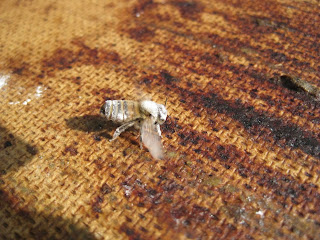
We did dust the bees for mites with powdered sugar before we left them. Here is one of them fanning to attract her sisters back to the hive.

And one trying to brush herself off.
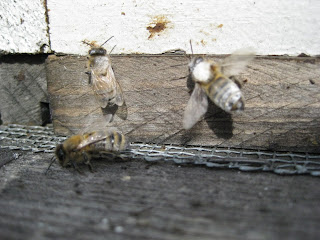

On the way home, we saw a few bees buzzing around the fruit trees that are blooming in the neighborhood, so there is still hope.
Please visit our shop to purchase Noe Valley Honey and other hive products from the Pollen Princesses.
When we got into the hive we got some mixed news.

We saw a few eggs! But at the same time the hive population is very small -- less than 1 lb of bees total from what I can estimate. And the eggs we did see were very few. Usually eggs are a good sign meaning that the queen is present and laying. With such a small population I expected we would be able to see the queen easily, though and we did not. So I have a suspicion that we have a laying worker and not a queen. This suspicion is strengthened by the fact that in at least one cell there were two eggs.
We'll wait a couple of weeks and see what happens. There is every likelihood that the reason the population is small is that is is late in the Winter. The queen, if she is present may simply not have started laying yet so the bees that remain are only those that have survived since October.
Once the eggs we did see hatch and the larvae are sealed in their cells we will be able to determine if they are workers or drones. And by that time if there is a queen there should be more laying.
If, on the other hand there is not more laying then we will know it is time to order a nuc or a package and start over.
There was not evidence of too many mites on the bottom board of the hive, and no signs of disease which is something to be grateful for.

We did dust the bees for mites with powdered sugar before we left them. Here is one of them fanning to attract her sisters back to the hive.

And one trying to brush herself off.


On the way home, we saw a few bees buzzing around the fruit trees that are blooming in the neighborhood, so there is still hope.
Please visit our shop to purchase Noe Valley Honey and other hive products from the Pollen Princesses.
Monday, October 20, 2008
Time to nestle in for Winter
We visited the hive once more yesterday. The super that was nearly full of honey, but not sealed last week was almost emptied out again. There was just about 3 frames of honey that was still not capped, though a shake test showed that it was pretty much cured.
The girls were just moving it down to the main hive bodies in preparation for huddling up for the Winter.
The bottom board was covered with mites that had been knocked off from the previous sugar dusting, but there didn't seem to be a significant number of mites actually on the bees themselves. Hopefully they are strong enough and the mites are few enough that they will make it for the next few months (really only three months or so here in California).
We took the super off and took the few frames with honey home to scrape. It isn't worth getting an extractor for just these three frames and there is wax left on one entire super and half of another to start them off next season. We examined a couple frames in the hive bodies and found the queen almost right away so we just closed the hive back up so as not to disturb them any more than necessary.
Finally we put on the entrance reducer to give them less area to defend while they are in their huddle and started to pack up. We put cedar chips in the boxes with the empty supers we left behind to discourage wax moths.
While were were packing up some of the field bees that had been out and about began to return. They flew to the entrance reducer and milled around on the surface trying to find where the big opening had gone. Meanwhile a few of their sisters from inside the hive peeked their tails out from under the hive cover which we have lifted a few mm with some pebbles from the inner cover to provide ventilation. When they started fanning a few field bees decided to give up on the search for the reduced main entrance opening and just went in the top. I hope that doesn't mean there is a risk of robbing through the top of the hive, but I think that they will be able to defend the inner cover opening alright.
We have come up with a nice design (I think) for the honey jar labels. We just need to get the actual adhesive paper and have them printed up. So keep an eye out for the product to go up in our shop.
In the meantime check out this woman's beautiful photography of bees in Australia. Amazing detail that she gets.
Please visit our shop to purchase Noe Valley Honey and other hive products from the Pollen Princesses.
The girls were just moving it down to the main hive bodies in preparation for huddling up for the Winter.
The bottom board was covered with mites that had been knocked off from the previous sugar dusting, but there didn't seem to be a significant number of mites actually on the bees themselves. Hopefully they are strong enough and the mites are few enough that they will make it for the next few months (really only three months or so here in California).
We took the super off and took the few frames with honey home to scrape. It isn't worth getting an extractor for just these three frames and there is wax left on one entire super and half of another to start them off next season. We examined a couple frames in the hive bodies and found the queen almost right away so we just closed the hive back up so as not to disturb them any more than necessary.
Finally we put on the entrance reducer to give them less area to defend while they are in their huddle and started to pack up. We put cedar chips in the boxes with the empty supers we left behind to discourage wax moths.
While were were packing up some of the field bees that had been out and about began to return. They flew to the entrance reducer and milled around on the surface trying to find where the big opening had gone. Meanwhile a few of their sisters from inside the hive peeked their tails out from under the hive cover which we have lifted a few mm with some pebbles from the inner cover to provide ventilation. When they started fanning a few field bees decided to give up on the search for the reduced main entrance opening and just went in the top. I hope that doesn't mean there is a risk of robbing through the top of the hive, but I think that they will be able to defend the inner cover opening alright.
We have come up with a nice design (I think) for the honey jar labels. We just need to get the actual adhesive paper and have them printed up. So keep an eye out for the product to go up in our shop.
In the meantime check out this woman's beautiful photography of bees in Australia. Amazing detail that she gets.
Please visit our shop to purchase Noe Valley Honey and other hive products from the Pollen Princesses.
Tuesday, September 9, 2008
Extracting
Perhaps I should back up a couple of weeks to our last adventure in extracting honey. If Deno has pictures (I'm sure he must) I'll have him add them.
We had taken one full super off of the hive back in July and remembering that our friends from the peninsula had asked if they could come see how we extract the honey some time, we called them up to set up a date.
We came up with a weekend in early August, and reserved the extractor and related equipment from the bee club. Since our friends were coming up on Sunday morning, we took the opportunity of having some of Saturday free to check the bees again. Good thing we did as we had another full super. We swapped it for an empty and took it home with us. We also went to buy some cheesecloth and paint straining bag.

Therefore, when our friends did arrive we had two full supers of honey. We all took turns uncapping the frames with the electric heated knife into the capping tank.
We lined the rack in the tank with some cheesecloth which resulted in less lost wax, less need to strain the honey from that tank, and easier cleanup since the wax was all in the cheesecloth.
We loaded the extractor three times. Having only nine frames in the honey supers not only reduces the labor of uncapping dramatically, but it also make everything divide into the 6 frame extractor evenly.

At one point, the extractor really bogged down and it took me a couple seconds to realize that the level of the honey in the drum was up to the bottom of the frames and thus dragging the frames considerably. We opened the gate valve on the extractor and let the honey start draining into our 5 gallon drum lined with the paint bag. (Note: next time line the paint bag with a layer or two of cheese cloth.) After that things sped up again.
All told we got over 4 1/2 gallons of honey (including what drained from the cappings) and almost half a kg of beeswax from the cappings.

Our friends seemed to be really amazed at the contents of the two supers. I admit, I was too. We actually got a second smaller container and drained some of the honey from the drum into it because we were afraid we'd over flow. We would not have after all, but it still made it easier to move the honey tank with out straining so much or fear of spilling.
When the jars we later ordered arrived (144 110ml hexagonal jars, and several 1lb. 12 sided jars) I decided it would make sense to run the honey through a chinoise to filter it a bit better. There were some visible bits of wax and bee pieces that had made it through the paint strainer.
We later took a partially filled super from them since I wanted to encourage them to start building up their own supplies. Sinc that only had five frames that were about 80% full, we just scraped the comb from them rather than extracting and let it all drain through a cheesecloth lined colander (A BIG ONE). That yielded another gallon even. So to date we have almost 8 gallons or somewhat more than 80lbs of honey. Family and friends have received some of it and we are working diligently on getting the rest labled.
Please visit our shop to purchase Noe Valley Honey and other hive products from the Pollen Princesses.
We had taken one full super off of the hive back in July and remembering that our friends from the peninsula had asked if they could come see how we extract the honey some time, we called them up to set up a date.
We came up with a weekend in early August, and reserved the extractor and related equipment from the bee club. Since our friends were coming up on Sunday morning, we took the opportunity of having some of Saturday free to check the bees again. Good thing we did as we had another full super. We swapped it for an empty and took it home with us. We also went to buy some cheesecloth and paint straining bag.

Therefore, when our friends did arrive we had two full supers of honey. We all took turns uncapping the frames with the electric heated knife into the capping tank.
We lined the rack in the tank with some cheesecloth which resulted in less lost wax, less need to strain the honey from that tank, and easier cleanup since the wax was all in the cheesecloth.
We loaded the extractor three times. Having only nine frames in the honey supers not only reduces the labor of uncapping dramatically, but it also make everything divide into the 6 frame extractor evenly.

At one point, the extractor really bogged down and it took me a couple seconds to realize that the level of the honey in the drum was up to the bottom of the frames and thus dragging the frames considerably. We opened the gate valve on the extractor and let the honey start draining into our 5 gallon drum lined with the paint bag. (Note: next time line the paint bag with a layer or two of cheese cloth.) After that things sped up again.
All told we got over 4 1/2 gallons of honey (including what drained from the cappings) and almost half a kg of beeswax from the cappings.

Our friends seemed to be really amazed at the contents of the two supers. I admit, I was too. We actually got a second smaller container and drained some of the honey from the drum into it because we were afraid we'd over flow. We would not have after all, but it still made it easier to move the honey tank with out straining so much or fear of spilling.
When the jars we later ordered arrived (144 110ml hexagonal jars, and several 1lb. 12 sided jars) I decided it would make sense to run the honey through a chinoise to filter it a bit better. There were some visible bits of wax and bee pieces that had made it through the paint strainer.
We later took a partially filled super from them since I wanted to encourage them to start building up their own supplies. Sinc that only had five frames that were about 80% full, we just scraped the comb from them rather than extracting and let it all drain through a cheesecloth lined colander (A BIG ONE). That yielded another gallon even. So to date we have almost 8 gallons or somewhat more than 80lbs of honey. Family and friends have received some of it and we are working diligently on getting the rest labled.
Please visit our shop to purchase Noe Valley Honey and other hive products from the Pollen Princesses.
Monday, September 8, 2008
Queen released
While I was away this weekend, Deno went to check the colony. The queen has been released from the cage and we already have some brood being sealed. Another two weeks and we'll have the new bees hatching and the colony will be out of danger.
Agnes is laying in the upper hive body which has me a little concerned because it will limit the space they have to store their winter supplies. If the brood does not move lower as the fall progresses, I think we'll have to take steps to rearrange the brood ourselves. Either by switching hive bodies or by moving a frame with the queen into the lower chamber and putting a queen excluder over it to keep her laying in the lower hive body until the upper hive bodies brood can hatch and the cells filled with nectar and pollen.
In California it is probably not a real crisis if there is less than 50 lbs of honey when they go into their winter cluser. Last year, they had about 70 lbs of surplus honey stored in the hive bodies for themselves when we put the entrance reducer on for the winter and when we first checked them in February they still had nearly 60 lbs remaining so they clearly were continually able to find nectar sources. However, if we have a long rainy spell they will have to depend on their stores. We need to plan for a wet winter just in case and make sure they have enough stores which means making room in the upper hive body while they still have time to collect nectar.
They have continued to bring in more fresh honey even without the queen and have filled the super that we have remaining about 1/3 with honey so far, although they have not started capping it yet so it is clearly not cured fully. Another month or so and we should be able to take of the last honey super with whatever extra honey they have placed in it.
Please visit our shop to purchase Noe Valley Honey and other hive products from the Pollen Princesses.
Agnes is laying in the upper hive body which has me a little concerned because it will limit the space they have to store their winter supplies. If the brood does not move lower as the fall progresses, I think we'll have to take steps to rearrange the brood ourselves. Either by switching hive bodies or by moving a frame with the queen into the lower chamber and putting a queen excluder over it to keep her laying in the lower hive body until the upper hive bodies brood can hatch and the cells filled with nectar and pollen.
In California it is probably not a real crisis if there is less than 50 lbs of honey when they go into their winter cluser. Last year, they had about 70 lbs of surplus honey stored in the hive bodies for themselves when we put the entrance reducer on for the winter and when we first checked them in February they still had nearly 60 lbs remaining so they clearly were continually able to find nectar sources. However, if we have a long rainy spell they will have to depend on their stores. We need to plan for a wet winter just in case and make sure they have enough stores which means making room in the upper hive body while they still have time to collect nectar.
They have continued to bring in more fresh honey even without the queen and have filled the super that we have remaining about 1/3 with honey so far, although they have not started capping it yet so it is clearly not cured fully. Another month or so and we should be able to take of the last honey super with whatever extra honey they have placed in it.
Please visit our shop to purchase Noe Valley Honey and other hive products from the Pollen Princesses.
Subscribe to:
Posts (Atom)

 Posts
Posts


