Now that we have extracted the final super of honey from the hive for the year, it's time to consider setting up the hive for success in overwintering. We have had less of a mite problem this year, thanks in no small part to investing a few more dollars in a mite-resistant queen. This colony has consequently been VERY fastidious about hygiene, sealing off everything that could be a potential entrance for pests with propolis, and disposing of debris (and infested brood) diligently.
Last year, I think the mites reached a level where they compromised the strength of the hive and we lost to colony to a host of pests including wax moths and hive beetles.
There is evidence this year of wax moths trying to make their presence felt, and we've seen several hive beetles scurrying around, but--from what information we can find--so long as the colony isn't being overwhelmed by mites, they should be able to keep the beetles and moths at bay.
However, we want to make sure the hive cover is well sealed, reduce the front entrance opening and we'll probably want to put the hive bodies on a solid bottom board in place of the screened bottom board we have now. That will minimize the ability of pests to enter, and interrupt the reproduction of the hive beetles (whose larvae leave the hive to mature in the ground under the hive and then climb back inside).
The bees are still pretty active right now, but shortly after Halloween we'll make one last check, dust with powdered sugar to help disperse any stray mites and minimize entrances.
In the temperate climate here in Sacramento, the bees won't have to expend too much energy keeping warm, and will still be able to get out and forage on the nicer days, so I have high hopes that they will weather this winter better than last year's colony.
Showing posts with label mites. Show all posts
Showing posts with label mites. Show all posts
Monday, October 20, 2025
Winterizing


Sunday, March 13, 2011
First Hive Visits of the Year
It's been while since the last post because it ended up being a tough year for the bees. Of our five hives, only two managed to hang on.
The diseased hive seemed to bounce back only to completely vanish a month later -- I suspect that was our first experience with colony collapse, but am not really sure. The other hive at our friend's limped along for a while, then petered out. They never really showed signs of illness, but the population just never got very big. One hive at the Dolores location suffered the same fate. There was a small population in November, so we let them go as they were but they did not make it through the winter.
Overall, 2010 was a very cold summer but also fairly dry for the area. I suspect that the bees did not get out to forage as much as they needed and that even when they did get out nectar was scarce. Consequently we simply did not harvest any honey last year. Anything that the bees did collect we left for them to get through the winter.
The two hives that we have left are bustling now, though. The one at Dolores is chock full of bees and I hope to have a chance to explore the hive more thoroughly to see how much nectar and pollen they have been bringing in, and to make sure they are standing up to mites and generally healthy. The hive on our friend's roof is also very busy, but a little smaller. We added a new honey super to the top and are hoping that they get right to work on it. There was plenty of brood, and plenty of honey, and quite a bit of new nectar.
The year seems to be off to a promising start.
Please visit our shop to purchase Noe Valley Honey and other hive products from the Pollen Princesses.
The diseased hive seemed to bounce back only to completely vanish a month later -- I suspect that was our first experience with colony collapse, but am not really sure. The other hive at our friend's limped along for a while, then petered out. They never really showed signs of illness, but the population just never got very big. One hive at the Dolores location suffered the same fate. There was a small population in November, so we let them go as they were but they did not make it through the winter.
Overall, 2010 was a very cold summer but also fairly dry for the area. I suspect that the bees did not get out to forage as much as they needed and that even when they did get out nectar was scarce. Consequently we simply did not harvest any honey last year. Anything that the bees did collect we left for them to get through the winter.
The two hives that we have left are bustling now, though. The one at Dolores is chock full of bees and I hope to have a chance to explore the hive more thoroughly to see how much nectar and pollen they have been bringing in, and to make sure they are standing up to mites and generally healthy. The hive on our friend's roof is also very busy, but a little smaller. We added a new honey super to the top and are hoping that they get right to work on it. There was plenty of brood, and plenty of honey, and quite a bit of new nectar.
The year seems to be off to a promising start.
Please visit our shop to purchase Noe Valley Honey and other hive products from the Pollen Princesses.
Sunday, November 22, 2009
Getting Ready for Winter
This past week has been about visiting all four of the hives that are still going and getting them set for the Winter. Not that Winter poses a big issue for the bees in the Bay Area, but still with much rain projected this year we want to make sure that the hives are set.

A few days back I visited the Dolores Park location to check the two hives there. One hive still had a lot of activity in both hive bodies, and brood and supplies in each. I took the super off the hive and set it aside for extraction -- about four full frames of honey there. The top hive body still has plenty of honey for the bees to use. They will have both hive bodies for the winter, but they seem to have a large population so it won't be an issue for them to heat.

The second hive had not been opened for a long time, though we took a super full of honey off it a couple of weeks ago. When I started pulling frames out of the upper hive body I realized that the entire upper body was all honey, no brood, no pollen.
The lower body contained a little brood and some eggs (meaning the queen is still present and healthy) and a lot of honey with some pollen. Clearly this hive has backed off on brood rearing in preparation for the Winter. I went ahead and took the hive body full of honey off and left just the one hive body for the bees. Less space for them to keep warm, but still plenty of supplies.

Rescuing honey!
On Saturday, we both went to our friend's to check the other two hives. These are both now very busy hives. Both hives had brood and supplies in both hive bodies, and the hive that had started out so slow actually had a super full of honey! The other stronger hive had a super full of capped honey, and one that just had a few frames of nectar not yet cured. We removed all the supers but left both hive bodies on each hive. We added entrance reducers to all the hives to aid in keeping down drafts and minimizing the need for them to dedicate guard bees when they need all the bodies they can get to keep warm.
We will extract all the honey in the supers and the one full hive body (another 80 lbs maybe?) The one super that has only nectar will be stored and returned to the bees in the Spring. They won't have to heat the space over the Winter, but they will have the supplies as a head start in the Spring.
A quick dusting of powdered sugar in all the remaining supers to keep the mites under control and we closed everyone back up. We'll come back to them in February or March, when the rains start to let up to check on how they fared.
Please visit our shop to purchase Noe Valley Honey and other hive products from the Pollen Princesses.

A few days back I visited the Dolores Park location to check the two hives there. One hive still had a lot of activity in both hive bodies, and brood and supplies in each. I took the super off the hive and set it aside for extraction -- about four full frames of honey there. The top hive body still has plenty of honey for the bees to use. They will have both hive bodies for the winter, but they seem to have a large population so it won't be an issue for them to heat.

The second hive had not been opened for a long time, though we took a super full of honey off it a couple of weeks ago. When I started pulling frames out of the upper hive body I realized that the entire upper body was all honey, no brood, no pollen.
The lower body contained a little brood and some eggs (meaning the queen is still present and healthy) and a lot of honey with some pollen. Clearly this hive has backed off on brood rearing in preparation for the Winter. I went ahead and took the hive body full of honey off and left just the one hive body for the bees. Less space for them to keep warm, but still plenty of supplies.

Rescuing honey!
On Saturday, we both went to our friend's to check the other two hives. These are both now very busy hives. Both hives had brood and supplies in both hive bodies, and the hive that had started out so slow actually had a super full of honey! The other stronger hive had a super full of capped honey, and one that just had a few frames of nectar not yet cured. We removed all the supers but left both hive bodies on each hive. We added entrance reducers to all the hives to aid in keeping down drafts and minimizing the need for them to dedicate guard bees when they need all the bodies they can get to keep warm.
We will extract all the honey in the supers and the one full hive body (another 80 lbs maybe?) The one super that has only nectar will be stored and returned to the bees in the Spring. They won't have to heat the space over the Winter, but they will have the supplies as a head start in the Spring.
A quick dusting of powdered sugar in all the remaining supers to keep the mites under control and we closed everyone back up. We'll come back to them in February or March, when the rains start to let up to check on how they fared.
Please visit our shop to purchase Noe Valley Honey and other hive products from the Pollen Princesses.
Wednesday, July 1, 2009
Two hives still lagging
Well, the slow start seems to be picking up finally. We have three hives that are doing quite well. These are all hives that came from packages or a split. The newest hive in the original yard is growing very rapidly. It took them a mere few weeks to fill the second hive body and now we have been able to add a honey super. 
The first hive at the Dolores location also has a honey super on it, but the bees have been reluctant to start using it. I drilled a hole into the front of the super to give the foragers an entrance above the queen excluder and hope that that will make it easier for them to start storing the nectar up there.
The second hive at that location is also growing rapidly, but not quite so rapidly as the one at the Chatanooga address. I have just added the second hive body to that hive -- perhaps a week or two later than I should have. Hopefully they will catch up quickly.
Unfortunately the most recent hive, which we started from a swarm and have already given a new queen is still very slow. The population is so small. The queen is still present, we have seen her milling about and she is laying eggs. However it is as though they just are not able to get the critical mass of population they need to start thriving. We took a frame each from the two hives at the Dolores Park location and added them to the poor hive to see if the newly hatched bees would give the hive a boost. We need to check soon to see if it has worked.
 Finally, our initial hive is also lagging. There continue to be a lot of dead bees around the entrance again. At first we thought it was the mites that were causing this, but after the mites had cleared up and the colony seemed to have bounced back, the population has dwindled a little again. There are eggs present and some capped brood. We added a frame of brood from the new hive at that location which is doing very well and again will see if that population boost helps the situation.
There are a number of diseases which can affect bees, aside from the mites which we treat with powdered sugar. Most of these diseases have distinctive characteristics like dead brood, strong smells, etc. But there are a couple which don't exhibit strong symptoms other than a general population decline. I am beginning to suspect nosema, which is a digestive disease of bees. It would explain the dead bees we find and the fact that the population remains small. We don't want to medicate so we will continue to watch and see what happens. Often, once there is substantial nectar available the disease will abate. We also gave them a patty of mint treated shortening and powdered sugar, which is a treatement for tracheal mites in case that is the problem. But in the case of tracheal mites, you will see the bees showing signs of fatigue or listlessness. Our bees appear perfectly healthy, except of course that they don't seem to be building the population.
Please visit our shop to purchase Noe Valley Honey and other hive products from the Pollen Princesses.
The first hive at the Dolores location also has a honey super on it, but the bees have been reluctant to start using it. I drilled a hole into the front of the super to give the foragers an entrance above the queen excluder and hope that that will make it easier for them to start storing the nectar up there.
The second hive at that location is also growing rapidly, but not quite so rapidly as the one at the Chatanooga address. I have just added the second hive body to that hive -- perhaps a week or two later than I should have. Hopefully they will catch up quickly.
Unfortunately the most recent hive, which we started from a swarm and have already given a new queen is still very slow. The population is so small. The queen is still present, we have seen her milling about and she is laying eggs. However it is as though they just are not able to get the critical mass of population they need to start thriving. We took a frame each from the two hives at the Dolores Park location and added them to the poor hive to see if the newly hatched bees would give the hive a boost. We need to check soon to see if it has worked.
Finally, our initial hive is also lagging. There continue to be a lot of dead bees around the entrance again. At first we thought it was the mites that were causing this, but after the mites had cleared up and the colony seemed to have bounced back, the population has dwindled a little again. There are eggs present and some capped brood. We added a frame of brood from the new hive at that location which is doing very well and again will see if that population boost helps the situation.There are a number of diseases which can affect bees, aside from the mites which we treat with powdered sugar. Most of these diseases have distinctive characteristics like dead brood, strong smells, etc. But there are a couple which don't exhibit strong symptoms other than a general population decline. I am beginning to suspect nosema, which is a digestive disease of bees. It would explain the dead bees we find and the fact that the population remains small. We don't want to medicate so we will continue to watch and see what happens. Often, once there is substantial nectar available the disease will abate. We also gave them a patty of mint treated shortening and powdered sugar, which is a treatement for tracheal mites in case that is the problem. But in the case of tracheal mites, you will see the bees showing signs of fatigue or listlessness. Our bees appear perfectly healthy, except of course that they don't seem to be building the population.
Please visit our shop to purchase Noe Valley Honey and other hive products from the Pollen Princesses.
Wednesday, April 15, 2009
Getting ready for more
We are going to spend this upcoming weekend installing three more hives around the City. One more at the original location, one more at the new location, and a final one on a friend's roof. Love that.
The first one will be another nuc -- these have worked out well for us so far. The other two will be packages that should be arriving this Saturday or Sunday. To get ready for them, Deno has been painting equipment and preparing sites.
We took a trip to see the second hive and it is doing quite well. We saw the queen almost right off and there are a lot of little larvae developing in nice patterns in the comb.
We realized on the last visit to the backyard hive that it seems to have a pretty sever mite infestation. This is a problem because the mites are infecting the larvae with a disease that causes stunted and misshaped wings. So we are going to be diligent about dusting all our colonies with powdered sugar to help them keep the mite populations at a minimum.
Here is a drone that was wondering on the gravel outside the hive and a worker bee with some powdered sugar. You can see the difference in size and shape and particularly how large the drone's eyes are compared with the worker bee.

When we dusted the colony they were a little frustrated with us and a lot of the bees that were at the top of the frames took off and started flying around. It is a good bet that a lot of these bees have not been out of the hive before, and of course we aren't really able to herd them back in before we close up. Fortunately, their sisters know what to do. The bees below with their tails in the air are releasing a the scent of the hive from their abdomens and fanning it out into the air with their wings so that any errant bees can find their way back to the hive by the smell.

On our way home, we discovered a large Pride of Madeira that was just covered with bees. Here we see a bumble bee and a honey bee (one of ours) sharing the tip of one of the spears of flowers.
They are perfectly content to share and don't bother one another in the slightest. Notice the bright lavender color of the pollen this one has packed on her legs. The pollen is used to feed the developing brood, so this time of year they are gathering large quantities to bring back to the hive.
Please visit our shop to purchase Noe Valley Honey and other hive products from the Pollen Princesses.
The first one will be another nuc -- these have worked out well for us so far. The other two will be packages that should be arriving this Saturday or Sunday. To get ready for them, Deno has been painting equipment and preparing sites.
We took a trip to see the second hive and it is doing quite well. We saw the queen almost right off and there are a lot of little larvae developing in nice patterns in the comb.
We realized on the last visit to the backyard hive that it seems to have a pretty sever mite infestation. This is a problem because the mites are infecting the larvae with a disease that causes stunted and misshaped wings. So we are going to be diligent about dusting all our colonies with powdered sugar to help them keep the mite populations at a minimum.
Here is a drone that was wondering on the gravel outside the hive and a worker bee with some powdered sugar. You can see the difference in size and shape and particularly how large the drone's eyes are compared with the worker bee.

When we dusted the colony they were a little frustrated with us and a lot of the bees that were at the top of the frames took off and started flying around. It is a good bet that a lot of these bees have not been out of the hive before, and of course we aren't really able to herd them back in before we close up. Fortunately, their sisters know what to do. The bees below with their tails in the air are releasing a the scent of the hive from their abdomens and fanning it out into the air with their wings so that any errant bees can find their way back to the hive by the smell.

On our way home, we discovered a large Pride of Madeira that was just covered with bees. Here we see a bumble bee and a honey bee (one of ours) sharing the tip of one of the spears of flowers.

They are perfectly content to share and don't bother one another in the slightest. Notice the bright lavender color of the pollen this one has packed on her legs. The pollen is used to feed the developing brood, so this time of year they are gathering large quantities to bring back to the hive.

Please visit our shop to purchase Noe Valley Honey and other hive products from the Pollen Princesses.
Monday, October 20, 2008
Time to nestle in for Winter
We visited the hive once more yesterday. The super that was nearly full of honey, but not sealed last week was almost emptied out again. There was just about 3 frames of honey that was still not capped, though a shake test showed that it was pretty much cured.
The girls were just moving it down to the main hive bodies in preparation for huddling up for the Winter.
The bottom board was covered with mites that had been knocked off from the previous sugar dusting, but there didn't seem to be a significant number of mites actually on the bees themselves. Hopefully they are strong enough and the mites are few enough that they will make it for the next few months (really only three months or so here in California).
We took the super off and took the few frames with honey home to scrape. It isn't worth getting an extractor for just these three frames and there is wax left on one entire super and half of another to start them off next season. We examined a couple frames in the hive bodies and found the queen almost right away so we just closed the hive back up so as not to disturb them any more than necessary.
Finally we put on the entrance reducer to give them less area to defend while they are in their huddle and started to pack up. We put cedar chips in the boxes with the empty supers we left behind to discourage wax moths.
While were were packing up some of the field bees that had been out and about began to return. They flew to the entrance reducer and milled around on the surface trying to find where the big opening had gone. Meanwhile a few of their sisters from inside the hive peeked their tails out from under the hive cover which we have lifted a few mm with some pebbles from the inner cover to provide ventilation. When they started fanning a few field bees decided to give up on the search for the reduced main entrance opening and just went in the top. I hope that doesn't mean there is a risk of robbing through the top of the hive, but I think that they will be able to defend the inner cover opening alright.
We have come up with a nice design (I think) for the honey jar labels. We just need to get the actual adhesive paper and have them printed up. So keep an eye out for the product to go up in our shop.
In the meantime check out this woman's beautiful photography of bees in Australia. Amazing detail that she gets.
Please visit our shop to purchase Noe Valley Honey and other hive products from the Pollen Princesses.
The girls were just moving it down to the main hive bodies in preparation for huddling up for the Winter.
The bottom board was covered with mites that had been knocked off from the previous sugar dusting, but there didn't seem to be a significant number of mites actually on the bees themselves. Hopefully they are strong enough and the mites are few enough that they will make it for the next few months (really only three months or so here in California).
We took the super off and took the few frames with honey home to scrape. It isn't worth getting an extractor for just these three frames and there is wax left on one entire super and half of another to start them off next season. We examined a couple frames in the hive bodies and found the queen almost right away so we just closed the hive back up so as not to disturb them any more than necessary.
Finally we put on the entrance reducer to give them less area to defend while they are in their huddle and started to pack up. We put cedar chips in the boxes with the empty supers we left behind to discourage wax moths.
While were were packing up some of the field bees that had been out and about began to return. They flew to the entrance reducer and milled around on the surface trying to find where the big opening had gone. Meanwhile a few of their sisters from inside the hive peeked their tails out from under the hive cover which we have lifted a few mm with some pebbles from the inner cover to provide ventilation. When they started fanning a few field bees decided to give up on the search for the reduced main entrance opening and just went in the top. I hope that doesn't mean there is a risk of robbing through the top of the hive, but I think that they will be able to defend the inner cover opening alright.
We have come up with a nice design (I think) for the honey jar labels. We just need to get the actual adhesive paper and have them printed up. So keep an eye out for the product to go up in our shop.
In the meantime check out this woman's beautiful photography of bees in Australia. Amazing detail that she gets.
Please visit our shop to purchase Noe Valley Honey and other hive products from the Pollen Princesses.
Sunday, September 28, 2008
Dusting
Yesterday, we went to pay the princesses a visit. We haven't taken a look at them since the week after we installed Agnes, the new Queen so they were do for a little check-up.
The hive looked to be in good shape and the honey super that we still have remaining is nearly full, though they have not started capping they honey yet. The top hive body was about 2/3 full of honey and a little pollen and the remainder in the center had healthy looking brood in all stages of development. We did see some eggs which is important since that indicates that the queen has been laying within the last three days. We did not see Agnes herself, but that is not surprising since we didn't pull out most of the frames -- just enough to get an idea of how much brood there was vs, food supplies.
We pulled a couple frames out of the lower hive body and sure enough there is quite a bit of brood down there as well. The lower hive body seemed to all be sealed brood -- but I did notice a few cells that were open, yet had underdeveloped chrysalises. I'll have to read up and see if I can figure out if that means anything. It didn't look like foulbrood of any kind or chalkbrood, and in the same frame we found three bees that were just emerging from their cells so I am not worried.
Finally before we started putting the boxes back on the hive, we dusted each layer liberally with powdered sugar. Sprinkling about 1/2 cup on the tops of the frames of each box, we used the bee brush to scatter the sugar down between the frames over all the bees before adding the next box on top of it.
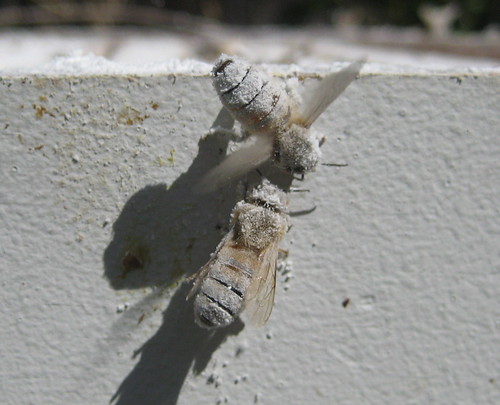 No, we don't think that the honey or the princesses themselves are not sweet enough. But this is an organic method of keeping the mite population at bay. The sugar dusting makes it harder for the mites to hold on to the bees. It also makes the bees groom themselves. The combination allows the bees to knock the mites off of themselves so they fall to the bottom of the hive. We use a screened bottom board so the mites fall right out of the hive where they can't reach the bees to get back in.
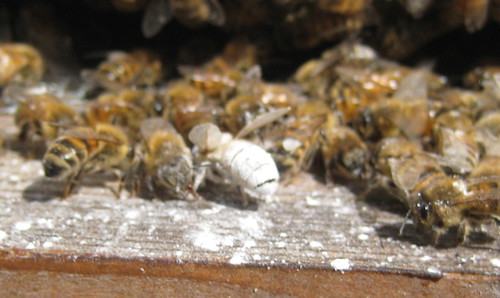
This is not a perfect method, but it does not resort to chemical pesticides which the mites may become resistant to or which may harm the bees and contaminate the hive and its products (read: honey, wax, propolis).
While we can't call our honey organic, because there is no way for us to control where the nectar is collected and there may be fertilizers or other chemicals used on the flowers the bees visit, we can make sure that we provide the bees with only natural, chemical free care and and clean naturally maintained hive.
 Later in the afternoon while I was in the back yard, I noticed that the ivy growing over the neighbors' fence was covered with bees (it is just now blooming teeny green flowers). I went to watch them and saw one with her back still covered with white powder -- one of the princesses had made it to our own backyard for a visit!
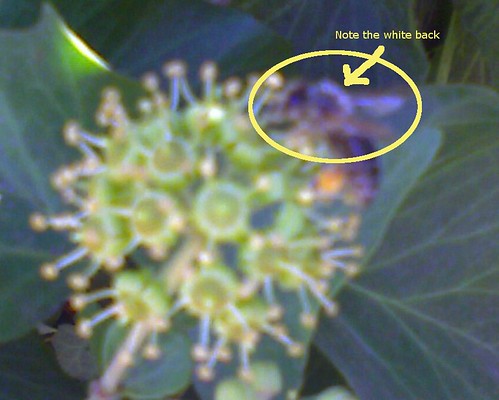 Pardon the poor photo.
Please visit our shop to purchase Noe Valley Honey and other hive products from the Pollen Princesses.
The hive looked to be in good shape and the honey super that we still have remaining is nearly full, though they have not started capping they honey yet. The top hive body was about 2/3 full of honey and a little pollen and the remainder in the center had healthy looking brood in all stages of development. We did see some eggs which is important since that indicates that the queen has been laying within the last three days. We did not see Agnes herself, but that is not surprising since we didn't pull out most of the frames -- just enough to get an idea of how much brood there was vs, food supplies.
We pulled a couple frames out of the lower hive body and sure enough there is quite a bit of brood down there as well. The lower hive body seemed to all be sealed brood -- but I did notice a few cells that were open, yet had underdeveloped chrysalises. I'll have to read up and see if I can figure out if that means anything. It didn't look like foulbrood of any kind or chalkbrood, and in the same frame we found three bees that were just emerging from their cells so I am not worried.
Finally before we started putting the boxes back on the hive, we dusted each layer liberally with powdered sugar. Sprinkling about 1/2 cup on the tops of the frames of each box, we used the bee brush to scatter the sugar down between the frames over all the bees before adding the next box on top of it.
No, we don't think that the honey or the princesses themselves are not sweet enough. But this is an organic method of keeping the mite population at bay. The sugar dusting makes it harder for the mites to hold on to the bees. It also makes the bees groom themselves. The combination allows the bees to knock the mites off of themselves so they fall to the bottom of the hive. We use a screened bottom board so the mites fall right out of the hive where they can't reach the bees to get back in. This is not a perfect method, but it does not resort to chemical pesticides which the mites may become resistant to or which may harm the bees and contaminate the hive and its products (read: honey, wax, propolis).
While we can't call our honey organic, because there is no way for us to control where the nectar is collected and there may be fertilizers or other chemicals used on the flowers the bees visit, we can make sure that we provide the bees with only natural, chemical free care and and clean naturally maintained hive.
Later in the afternoon while I was in the back yard, I noticed that the ivy growing over the neighbors' fence was covered with bees (it is just now blooming teeny green flowers). I went to watch them and saw one with her back still covered with white powder -- one of the princesses had made it to our own backyard for a visit! Pardon the poor photo.Please visit our shop to purchase Noe Valley Honey and other hive products from the Pollen Princesses.
Tuesday, September 9, 2008
Extracting
Perhaps I should back up a couple of weeks to our last adventure in extracting honey. If Deno has pictures (I'm sure he must) I'll have him add them.
We had taken one full super off of the hive back in July and remembering that our friends from the peninsula had asked if they could come see how we extract the honey some time, we called them up to set up a date.
We came up with a weekend in early August, and reserved the extractor and related equipment from the bee club. Since our friends were coming up on Sunday morning, we took the opportunity of having some of Saturday free to check the bees again. Good thing we did as we had another full super. We swapped it for an empty and took it home with us. We also went to buy some cheesecloth and paint straining bag.

Therefore, when our friends did arrive we had two full supers of honey. We all took turns uncapping the frames with the electric heated knife into the capping tank.
We lined the rack in the tank with some cheesecloth which resulted in less lost wax, less need to strain the honey from that tank, and easier cleanup since the wax was all in the cheesecloth.
We loaded the extractor three times. Having only nine frames in the honey supers not only reduces the labor of uncapping dramatically, but it also make everything divide into the 6 frame extractor evenly.

At one point, the extractor really bogged down and it took me a couple seconds to realize that the level of the honey in the drum was up to the bottom of the frames and thus dragging the frames considerably. We opened the gate valve on the extractor and let the honey start draining into our 5 gallon drum lined with the paint bag. (Note: next time line the paint bag with a layer or two of cheese cloth.) After that things sped up again.
All told we got over 4 1/2 gallons of honey (including what drained from the cappings) and almost half a kg of beeswax from the cappings.

Our friends seemed to be really amazed at the contents of the two supers. I admit, I was too. We actually got a second smaller container and drained some of the honey from the drum into it because we were afraid we'd over flow. We would not have after all, but it still made it easier to move the honey tank with out straining so much or fear of spilling.
When the jars we later ordered arrived (144 110ml hexagonal jars, and several 1lb. 12 sided jars) I decided it would make sense to run the honey through a chinoise to filter it a bit better. There were some visible bits of wax and bee pieces that had made it through the paint strainer.
We later took a partially filled super from them since I wanted to encourage them to start building up their own supplies. Sinc that only had five frames that were about 80% full, we just scraped the comb from them rather than extracting and let it all drain through a cheesecloth lined colander (A BIG ONE). That yielded another gallon even. So to date we have almost 8 gallons or somewhat more than 80lbs of honey. Family and friends have received some of it and we are working diligently on getting the rest labled.
Please visit our shop to purchase Noe Valley Honey and other hive products from the Pollen Princesses.
We had taken one full super off of the hive back in July and remembering that our friends from the peninsula had asked if they could come see how we extract the honey some time, we called them up to set up a date.
We came up with a weekend in early August, and reserved the extractor and related equipment from the bee club. Since our friends were coming up on Sunday morning, we took the opportunity of having some of Saturday free to check the bees again. Good thing we did as we had another full super. We swapped it for an empty and took it home with us. We also went to buy some cheesecloth and paint straining bag.

Therefore, when our friends did arrive we had two full supers of honey. We all took turns uncapping the frames with the electric heated knife into the capping tank.
We lined the rack in the tank with some cheesecloth which resulted in less lost wax, less need to strain the honey from that tank, and easier cleanup since the wax was all in the cheesecloth.
We loaded the extractor three times. Having only nine frames in the honey supers not only reduces the labor of uncapping dramatically, but it also make everything divide into the 6 frame extractor evenly.

At one point, the extractor really bogged down and it took me a couple seconds to realize that the level of the honey in the drum was up to the bottom of the frames and thus dragging the frames considerably. We opened the gate valve on the extractor and let the honey start draining into our 5 gallon drum lined with the paint bag. (Note: next time line the paint bag with a layer or two of cheese cloth.) After that things sped up again.
All told we got over 4 1/2 gallons of honey (including what drained from the cappings) and almost half a kg of beeswax from the cappings.

Our friends seemed to be really amazed at the contents of the two supers. I admit, I was too. We actually got a second smaller container and drained some of the honey from the drum into it because we were afraid we'd over flow. We would not have after all, but it still made it easier to move the honey tank with out straining so much or fear of spilling.
When the jars we later ordered arrived (144 110ml hexagonal jars, and several 1lb. 12 sided jars) I decided it would make sense to run the honey through a chinoise to filter it a bit better. There were some visible bits of wax and bee pieces that had made it through the paint strainer.
We later took a partially filled super from them since I wanted to encourage them to start building up their own supplies. Sinc that only had five frames that were about 80% full, we just scraped the comb from them rather than extracting and let it all drain through a cheesecloth lined colander (A BIG ONE). That yielded another gallon even. So to date we have almost 8 gallons or somewhat more than 80lbs of honey. Family and friends have received some of it and we are working diligently on getting the rest labled.
Please visit our shop to purchase Noe Valley Honey and other hive products from the Pollen Princesses.
Monday, September 8, 2008
Queen released
While I was away this weekend, Deno went to check the colony. The queen has been released from the cage and we already have some brood being sealed. Another two weeks and we'll have the new bees hatching and the colony will be out of danger.
Agnes is laying in the upper hive body which has me a little concerned because it will limit the space they have to store their winter supplies. If the brood does not move lower as the fall progresses, I think we'll have to take steps to rearrange the brood ourselves. Either by switching hive bodies or by moving a frame with the queen into the lower chamber and putting a queen excluder over it to keep her laying in the lower hive body until the upper hive bodies brood can hatch and the cells filled with nectar and pollen.
In California it is probably not a real crisis if there is less than 50 lbs of honey when they go into their winter cluser. Last year, they had about 70 lbs of surplus honey stored in the hive bodies for themselves when we put the entrance reducer on for the winter and when we first checked them in February they still had nearly 60 lbs remaining so they clearly were continually able to find nectar sources. However, if we have a long rainy spell they will have to depend on their stores. We need to plan for a wet winter just in case and make sure they have enough stores which means making room in the upper hive body while they still have time to collect nectar.
They have continued to bring in more fresh honey even without the queen and have filled the super that we have remaining about 1/3 with honey so far, although they have not started capping it yet so it is clearly not cured fully. Another month or so and we should be able to take of the last honey super with whatever extra honey they have placed in it.
Please visit our shop to purchase Noe Valley Honey and other hive products from the Pollen Princesses.
Agnes is laying in the upper hive body which has me a little concerned because it will limit the space they have to store their winter supplies. If the brood does not move lower as the fall progresses, I think we'll have to take steps to rearrange the brood ourselves. Either by switching hive bodies or by moving a frame with the queen into the lower chamber and putting a queen excluder over it to keep her laying in the lower hive body until the upper hive bodies brood can hatch and the cells filled with nectar and pollen.
In California it is probably not a real crisis if there is less than 50 lbs of honey when they go into their winter cluser. Last year, they had about 70 lbs of surplus honey stored in the hive bodies for themselves when we put the entrance reducer on for the winter and when we first checked them in February they still had nearly 60 lbs remaining so they clearly were continually able to find nectar sources. However, if we have a long rainy spell they will have to depend on their stores. We need to plan for a wet winter just in case and make sure they have enough stores which means making room in the upper hive body while they still have time to collect nectar.
They have continued to bring in more fresh honey even without the queen and have filled the super that we have remaining about 1/3 with honey so far, although they have not started capping it yet so it is clearly not cured fully. Another month or so and we should be able to take of the last honey super with whatever extra honey they have placed in it.
Please visit our shop to purchase Noe Valley Honey and other hive products from the Pollen Princesses.
Friday, September 5, 2008
Requeened
It appeared two weeks ago, upon examining the hives that the current queen, Heather had either absconded or simply been smashed when we tried to reverse the hive bodies.
Unfortunately, although there were plenty of eggs at the time the bees did not see fit to raise a new monarch and when we opened the hive there was no brood whatsoever.
We originally were going to trade for a frame of eggs and brood from another local beekeeper in Glen Park, but then heard about a couple who had unnecessarily ordered a new queen for their hive in the avenues. I contacted them and took Muni out to their house last Friday to pick her up. We installed the queen in her cage the next morning and dubbed her Agnes - as in Gooch from Auntie Mame. "I liiiived! I need to know what I should do now!"
Whilst I am away this weekend, Deno will go and check on the hive to make sure the queen has been released and is laying eggs and do a third dusting of powdered sugar to keep the mites in check before the fall.
He'll also be able to take the empty honey super we put on top of the hive for cleaning and pack it away.
I imagine we'll get one final batch of the really tasty honey (maybe a gallon or so) before the season is over so stay posted.
Please visit our shop to purchase Noe Valley Honey and other hive products from the Pollen Princesses.
Unfortunately, although there were plenty of eggs at the time the bees did not see fit to raise a new monarch and when we opened the hive there was no brood whatsoever.
We originally were going to trade for a frame of eggs and brood from another local beekeeper in Glen Park, but then heard about a couple who had unnecessarily ordered a new queen for their hive in the avenues. I contacted them and took Muni out to their house last Friday to pick her up. We installed the queen in her cage the next morning and dubbed her Agnes - as in Gooch from Auntie Mame. "I liiiived! I need to know what I should do now!"
Whilst I am away this weekend, Deno will go and check on the hive to make sure the queen has been released and is laying eggs and do a third dusting of powdered sugar to keep the mites in check before the fall.
He'll also be able to take the empty honey super we put on top of the hive for cleaning and pack it away.
I imagine we'll get one final batch of the really tasty honey (maybe a gallon or so) before the season is over so stay posted.
Please visit our shop to purchase Noe Valley Honey and other hive products from the Pollen Princesses.
Subscribe to:
Posts (Atom)

 Posts
Posts

