Showing posts with label fresh honey. Show all posts

Sunday, July 12, 2026

Two new batches!

We were away for a few weeks, but now we're back. We saw that there was one super that was about 75% capped when we left so we knew we wanted to check on it soon after returning. What we didn't expect was the next super on top of that was also going to be full and capped.
So, this past weekend we harvested and extracted two supers of honey: Early summer (late June) and Summer (July). We may find we have a late July harvest as well...but that remains to be seen.
The early summer super definitely has a fruit quality.  I think it is apple/pear related. My husband gets vestiges of citrus blossom and stone fruit. Regardless,  it's sweet but not jam like.  The fruit is definitely crisp and bright.
The second super a few weeks later is definitely summer flowers and darker fruit notes. Jasmine, lavender and blackberry blossoms with a sense of allspice on the finish (thistle?)
I've got jars on order, but a few jars of the early summer are available now. The rest should be out by end of week.

Wednesday, June 17, 2026

We now have April and June 2026 extractions

We were able to harvest and extract another 2.25 gallons of honey and extract it last weekend.  We have it bottled and newly available in our stand. This super seemed to have even more of the citrus and mockorange nectar in it providing a very sweet floral bouquet to highlight a fresh and mildly sweet flavor. Less herbal than the April extraction, but still with a slight green bitter finish -- like lime zest?
Come try it for yourself.

Saturday, May 9, 2026

It took some time, but we've harvested

Only the first super so far.  We added a third recently. They have drawn out comb in that super and there's plenty of nectar in it. The second super we added near the end of March is full, but not yet completely capped, so we're leaving it for another week or so.
We went ahead and extracted right away while we have some time, and should have some honey bottled soon! Yum.


Sunday, March 29, 2026

Exactly four weeks later

...we checked to see how the first super was being filled. We are surprised to learn that it is already completely full and capped. We have added a second super with comb already drawn from last year. We left the full super on because we are not prepared to do an extraction any time soon (maybe next week) and the bees will keep the honey from pests for us in the mean time. It will also hopefully lead the bees to start filling the new super.
Short story is: we should have honey available before May...(fingers crossed).
Last Week

Today
We want the hive to have a start filling the new super, find time to extract, prepare jars, bottle and label, get the stand out again....

Sunday, October 5, 2025

New, and final extraction of the year

Last weekend we were able to get into the hive and remove the last honey super for the year.  This involves removing each frame of honey one by one, brushing the bees off and back into the hive and removing the frame to a new box away from the bees.
Brushing bees from a frame of honey to be extracted.

We were able to extract the honey this weekend, and ended up with just exactly 2.5 gallons, 30lbs.  This batch is really fun.  Very dark in color, it's moderately sweet with a somewhat bitter finish -- very autumnal.  What makes it exciting though is it has a cedar-y sort of nose and a decidedly toffee (coffee?) taste with woodsy notes.
Wax comb emptied of the honey.
We have let it filter through a paint bag (bought fresh for this purpose) to remove the bits of wax that inevitably end up in the centrifugal extractor.  And will put it in jars soon, so look for it in our little stand sometime in the next week or so. Then you can try it for yourself.

Saturday, September 13, 2025

Updating Some Branding

Since we are in a new town and new neighborhood, of course we want to label our honey appropriately.  I had just decided that I would keep our original logo and font for the jar labels, and simply change the text to the East Sacramento origin of the nectar.

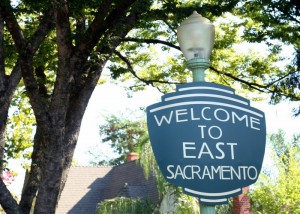
However, it occurred to me (if a bit late) that East Sacramento actually has its own branding from 2009.  The McKinley East Sacramento Neighborhood Association and the East Sacramento Improvement Association joined forces with the East Sacramento Chamber of Commerce and commissioned 7 Welcome to East Sacramento Signs.
From the East Sacramento Community Assn.

The outline and frame of the signs echoes the shape of the East Lawn Cemetery clock.
Eastlawn Clock, SacramentoRevealed.com

It has since become popular for homes to display replicas of the signs in yard or on house-fronts.
A little searching for a decent imitation of the typeface and adapting the scale to fit a label and I present:


What do you think?

We'll keep the original for the shop branding, but this will go on the local honey jars.

Sunday, August 24, 2025

New extraction today

Last week, we were able to remove one of the two supers from the hive.  The other super (put on about two weeks ago, when the existing super was about 85% full) has most of the wax drawn out by the bees, but they have only just started adding nectar to the cells so it might be another two to three weeks before we will consider adding another super, or just letting them fill that second super and leave them to prepare for autumn.
It is a not too sweet and rather dark honey, much darker than our first extractions last year.  Sadly, we had a little wax moth damage in part of one frame so we didn't extract that frame.  We set it in the freezer to kill any remaining wax moth remnants and will return the frame to the hive for the bees to clean out, along with the empty comb.
We're filtering the resulting 2 gallons of honey as we speak (type...read...?) and will be ready to put in in jars by this coming weekend, so then we will have 6 variations on offer in our little stand.  Though we are down to less than half a gallon of two of those variations.
[The little stand has received a few visitors already.  Thank you if you were one of them.  We're working on getting some signs up to direct traffic our way, and maybe a few little jars with samples and some coffee stirrers for tasting...?]

Saturday, August 23, 2025

And we're stocked!

We have our honor stand up and available!

Stand stocked and ready to sell

Come get some to take home yourself!

Sunday, August 17, 2025

Almost Ready to Sell Again

This weekend we were able to remove a super for extraction.  We have another super on top, but it did not have comb built out, so the bees had to take the time to draw the wax and it has very little honey added to it yet.
The weekend also sees us almost ready to start selling our honey again.
I ordered new jars a few weeks ago, and we filled them and labelled them.
We have just about finished a little cabinet where we can put the jars for sale near our sidewalk.
I've made a little poster/price list with a QR code to accept payments, and there is a cash slot in the cabinet as well.
The honor system honey cabinet

I've printed up the descriptions of each harvest to hang on the shelves by the jars.
The cabinet still needs a couple shelves, and I should find a way to put a little color code sticker on the jars to distinguish the different harvests.
I have sold ~15 jars to staff at school already, but now we can reach more of the local residents.
I'll put up a new post once we have the stand set up and ready.
Find us in East Sacramento.


Sunday, August 3, 2025

New Bottling - Updated

New jars arrived.  I have dug up the old labelling materials.  Spent a little time this morning bottling some of the honey that we harvested last year.  There is one more batch of honey from the year prior that can be bottled, once we have warmed it slightly; it has crystallized in the intervening year and I want to gently re-liquify it. [Update -- I have bottled a few jars of this now too!]

I've updated the labels to reflect our new location.
The artists and their work.

We have four different harvests from last year ready to go: 
top: Spring 2024
bottom left to right: early and mid-summer, and early fall
Summer 2023
This light amber honey, harvested in 2023 from our East Sacramento garden, is bursting with the taste of summer. It has a beautiful fruity essence, evoking notes of stonefruit (almond, peach and apricot). The finish is a beautiful combination of a soft, floral undertone and a unique marshmallow-like sweetness. (not pictured)

Late spring 
A delicate and light amber honey harvested from the early spring blossoms of East Sacramento. Bees forage on blooming early almond,  fruit trees and local wildflowers, creating a mild, floral flavor with subtle notes of almond blossoms subtle herbs and a nice floral finish.

Early summer
Crafted from the rich, summer bloom of East Sacramento, this honey is a bolder expression of the season. Our bees collect nectar from hearty plants like sages, mock orange, and lavender, giving the honey a distinct golden color and a complex, aromatic sweetness with distinct herbal notes and amazing orange blossom inspired finish. 

Mid summer
A robust, deep amber honey harvested from East Sacramento's mid-summer bloom. Bees forage on late-season wildflowers and tenacious urban flora like star thistle, sunflower and summer herbs like basil, oregano and thyme. The result is a viscous, crystalline, honey with a complex, herbal and earthy sweetness with a somewhat bitter finish.

Fall
A silky, deep amber honey, capturing the last blooms of an East Sacramento fall. Bees forage on late-season flowers like allium, goldenrod and herbs. The result brings a lovely clean sweetness with light hints of clay and spice. 

Now for marketing. I am disenchanted with Etsy, where we used to sell, and we don't have a relationship with any local market yet like we did with Bi-Rite in San Francisco. I am half-tempted to just create a little honor-system stand in the front yard with a little cash box, or a QR code to my square....

I have only bottled less than half so far; I want to see what sizes sell in which harvest before I commit all of the jars.  I'd rather sell out of a particular harvest than have to backorder while I get more jars.


Thursday, July 31, 2025

Trying to get back in the routine

It has been a decade since we have had the capacity to keep bees in the City. However, in 2021 we took advantage of the housing sales slump to relocate to Sacramento. Having our own house with our own yard means we get to have our own hives again and so we have started beekeeping once more.

Over the intervening decade, it has become more challenging to maintain a healthy hive; the increase in types and tenacity of various parasitic pests in the hive means that the colony is now contending with hive beetles and wax moths while still battling mites. The mites are now spreading deformed wing virus which adds a new layer of challenge. But at the same time, mite treatments are more varied with simple things to keep the mite population down such as managing drone brood and periodic dusting with sugar coupled with more aggressive miticide treatments when mite counts start to rise.

Keeping the mites at bay allows the bees to focus on keeping the other pests at bay and gives them a decent chance at survival. This year we replaced our queen with a new variety that shows promise in mite resistance (Olivarez Golden West). So far, it seems to be working, I have seen very few mites on our bottom board and though there have been a few beetle sightings, there doesn't seem to be significant interference from them in the hive activity.

Last summer (with our nephew's help), we were able to extract a little over 12 gallons of honey. We like to extract the supers individually to get the character of the nectar as the season progresses.


The earlier extractions were very light in color and fragrantly sweet. The later season supers were substantially darker in color, but somewhat less viscous, less sweet and much more herbal in character. I've ordered a batch of jars and updated our labels so hopefully we will be ready to sell again in the very near future.

For this year, we have one super nearing 80% capped. We added a second super recently and the colony population seems very robust. I anticipate at least 5 gallons of harvest by the autumn.

Sunday, September 4, 2011

Finally

It has been another roughish year for the bees, though not so bad as last year. We only had one colony really do well this year, and it currently seems to be struggling -- there does not seem to be any sign of a queen after a late swarm. We were able to capture a different swarm and start a new colony, hopefully it will be able to get itself up and running before the weather turns too cold and wet.

The good news is that the one hive that has been doing well for most of the summer has produced about 30 lbs. of honey for us so we will be able to get a small shipment to Bi-Rite for the fall and hopefully for the holidays as well. We are just working on getting it into jars and labeled now, so look for it in less than a week.

Please visit our shop to purchase Noe Valley Honey and other hive products from the Pollen Princesses.

Sunday, March 13, 2011

First Hive Visits of the Year

It's been while since the last post because it ended up being a tough year for the bees. Of our five hives, only two managed to hang on.

The diseased hive seemed to bounce back only to completely vanish a month later -- I suspect that was our first experience with colony collapse, but am not really sure. The other hive at our friend's limped along for a while, then petered out. They never really showed signs of illness, but the population just never got very big. One hive at the Dolores location suffered the same fate. There was a small population in November, so we let them go as they were but they did not make it through the winter.

Overall, 2010 was a very cold summer but also fairly dry for the area. I suspect that the bees did not get out to forage as much as they needed and that even when they did get out nectar was scarce. Consequently we simply did not harvest any honey last year. Anything that the bees did collect we left for them to get through the winter.

The two hives that we have left are bustling now, though. The one at Dolores is chock full of bees and I hope to have a chance to explore the hive more thoroughly to see how much nectar and pollen they have been bringing in, and to make sure they are standing up to mites and generally healthy. The hive on our friend's roof is also very busy, but a little smaller. We added a new honey super to the top and are hoping that they get right to work on it. There was plenty of brood, and plenty of honey, and quite a bit of new nectar.

The year seems to be off to a promising start.

Please visit our shop to purchase Noe Valley Honey and other hive products from the Pollen Princesses.

Tuesday, August 10, 2010

Update on the Diseased Hives

Well, we have lost both hives from our friend's yard. It's a bit disappointing, but one of the things that happens when you are dealing with nature.
The smaller hive just eventually petered out. There simply wasn't enough population to sustain the colony. Still not sure what caused the decline -- typically I'd expect colony collapse to have happened much more suddenly, with the bees just leaving the hive, not dwindling away like this colony did. I suspect it may have been a case of nosema that they were simply unable to weather.
The foulbrood hive was confirmed to be European foulbrood, so we proceeded with our plans to salvage the colony. We were able to transfer the adult bees into a fresh clean hive, then sterilize all the hive components of the old hive with a blowtorch.
We kept the colony quarantined and closed in with screen in the new hive for two days, then transferred them into a second new hive with sugar water to feed them, still keeping them screened in for a few more days. Then we removed the screen and let them go about their business.
California Poppy
Within a week the queen was laying eggs again and brood was developing. The brood developed well and things seemed to be just fine for the colony.
Unfortunately, the colony absconded from the hive last week -- the entire group just left. Maybe this time it WAS colony collapse; the symptoms seem right. The brood that remained of course all died because there were no nurse bees to care for them, but they looked as if they were healthy until then; there was still no sign of foulbrood in the new brood.

The hives near Dolores are still doing pretty well, but the nectar flow seems to be slow -- it's been a very cold summer here in the City so they may just not be finding as much nectar as they might otherwise. One hive is doing very well, the other is a little slower -- both seemed to have spotty laying patterns at the last inspection, but the queen was seen in one, and eggs and worker brood were seen in the other so the queens are present. We'll keep an eye on them.
Rose of Sharon

Please visit our shop to purchase Noe Valley Honey and other hive products from the Pollen Princesses.

Monday, June 14, 2010

Bad News in a Couple Hives

This past weekend was magnificent weather here in the City, perhaps attributable to global warming or just El Niño. At any rate, Sunday was a great day to visit the bees. We brought a friend of ours along who has kept bees with his dad in PA for ten years.

The hives near Dolores park seem to be doing alright -- one of them is humming right along, with a healthy amount of brood and almost a full super of honey. I'll be adding a second super to that hive in a week or two while they finish filling this super and cap the honey. The second hive, which was started as a split from the first hive has several eggs and a queen but the population is a little on the low side -- I'm going to give them the shortening and sugar patty treatment in case it is tracheal mites. This treatment worked very well last year with a flagging hive. Otherwise we'll just keep an eye on them and monitor the population. If they are suffering from Nosema, there is not a lot we can do but hope they are able to weather it (just like the flu for us).

We then trekked over to our friend's yard to see the hives there. He has recently started his own hive there from a package because he's interested in watching his own colony up-close. The colony has really taken off over the past couple of weeks with LOTS of brood and a good amount of nectar collected. They've even begun to cap some honey at the top of a few frames. It is very nearly time for him to expand that hive to a second hive body.

The two hives we have at that location are not doing well at all though. The smaller hive, which we began as a split from the first hive had started out very well, but the population has simply dwindled away. There are now only a few dozen bees (instead of a few dozen thousand) and the queen is dead or missing. It is hard to say what happened, it could be colony collapse, though that has not been a problem for us before, or more likely it is that the hive we split them from was diseased to begin with and the new colony could not battle the disease.

The larger hive from which we took the split seemed to be just booming earlier in the year, but when we opened the hive last week, we noticed that the bottom chamber was simply empty -- all the bees were in the top. We planned on swapping chambers this week, but when we opened the hive we noticed that there was nothing but capped brood -- not much in the way of supplies, honey or pollen, and no larvae or eggs. The brood caps were also very dark. I pulled a stalk of dried grass and pierced a few of the caps -- yes I would have to kill a few larvae to try and diagnose what was happening, sad, but necessary. Instead of ooozing creamy white as a healthy larvae would, the cells instead contained a sort of beige goo with a lugubrious consistency and a kind of off smell: foulbrood!

This is a disease that infects developing larvae, killing them off and disintegrating the bodies in the cell. The adult bees are not affected, but they are also unable to clean the cells because of the consistency of the dead brood. The spores of the disease get into the honey, wax and even the wood of the hive so there is no way for the bees to rid themselves of it.

We are going to try to save the colony (assuming the queen is still present), though we will have to put them in all new clean equipment, replace the frames and foundation and destroy all the existing foundation, wax and honey.

We hope to be able to shake the adult bees and queen into a clean nuc and close them off for a day without foraging, then transferring them back to a new clean hive and basically treating them as a captured swarm or a new package. This time of separation appears to be a sufficient quarantine to keep the adults from reintroducing the disease into the new hive.

Failing that, we will have to re-sterilize the equipment by scorching it with a torch, then start with a new, healthy colony. Either way -- our honey production this year is going to be severely reduced as both hives that we use for the Pollen Princess label will basically have to start over. The honey from the Dolores park location will still be available at Bi-Rite under their label once the bees have brought in enough surplus to harvest. We will also hopefully be able to harvest and bottle some honey from our newest hive just below Corona Heights above the Castro.

Please visit our shop to purchase Noe Valley Honey and other hive products from the Pollen Princesses.

Friday, April 9, 2010

Gearing Up


About a month ago, we made the rounds of our hives to see how everyone had fared through the winter. At each location, interestingly enough, we found one strong hive that was already building a strong population and one hive that was nearly dead (if not completely dead). I don't believe that either of the dead hives was caused by colony collapse -- the bees did not just disappear from either one, that I can tell. Each of them had a colony that was a bit on the small side at the end of the fall, and I just don't believe they had a critical mass of population to maintain themselves through the winter.
At any rate, rather than ordering new packages for these two hives, we decided to do a split from the healthy hives at each location. We chose 5 frames from each healthy hive that were heavy with developing brood and eggs, and swapped them out with five empty frames from the empty hives. The hope was that the while the brood on these frames was hatching to maintain the population, the bees would raise one of the eggs as a new queen.
Yesterday and today, I made the rounds again and checked both locations -- in each location the strong hives were ready for their first honey super (yeay!). In fact at the Dolores Park location, it appeared that the colony was preparing swarm cells. I am pretty confident that I was able to get them a new super in time, but they were quite ready for more space.
What I really was anxious to learn though was whether the two weak hives were able to produce a new queen and whether she was successful in mating. At Dolores Park, I examined just a few frames before I found copious amounts of eggs in the cells! Some of the cells on one frame side seemed to have some strange laying patterns, such as more than one egg in a cell, or eggs attached to the side, rather than the bottom of the cell, but they overall laying pattern was good on the rest of the frames I examined, so I imagine that the one frame was just from the queen's early attempts as she first started laying.


At the other location the weak hive seemed to have a decent sized population, all things considered. However as I started examining the frames I could not find any eggs at all; frame after frame and all I found were adult bees. I was just about to close up the hive and run home to order a queen to give the hive, when I saw this!

VoilĂ  la Reine! She appears to be plump enough that I believe she has mated already, she must not have started laying quite yet though. We'll give this hive a little more time and check again, but I think they are going to be alright.


Please visit our shop to purchase Noe Valley Honey and other hive products from the Pollen Princesses.

Monday, April 5, 2010

Heater Bees

It has long been recognized how well bees can maintain the temperature of their hive. By shivering to warm the hive or bringing in water and using their wings to evaporate it to cool.
Now researchers in Germany have determined how precisely temperature plays a role in the hive and specifically in the development of the bees' larvae.

Fascinating!

Read the article in the Telegraph here.

Please visit our shop to purchase Noe Valley Honey and other hive products from the Pollen Princesses.

Tuesday, February 2, 2010

I knew they could recognize a face

But I did not know that they can distinguish one face from another.

Here is a recent article from the New York Times about a study showing that bees can recognize a face and distinguish one face from another. Since I know from personal experience that bees target one's face when they are angry and wanting to sting you, I didn't find the fact that they can distinguish a face from, say, a chair. But I did not realize that they may be able to recognize an individual face from another.

http://www.nytimes.com/2010/02/02/science/02bees.html?ref=science


Please visit our shop to purchase Noe Valley Honey and other hive products from the Pollen Princesses.
Friday, January 29, 2010

Bees on the Rebound?

A friend of mine sent me a link to a Gawker post regarding this article from Delaware. It says that there are somewhat fewer reports of missing bees than in years past, although the numbers of disappearing colonies are still high. Dare we hope that things are improving and the bees are returning?


Please visit our shop to purchase Noe Valley Honey and other hive products from the Pollen Princesses.

Wednesday, January 13, 2010

Bottling Time

Looks like the next few days (if not longer) are going to be devoted to bottling the 80+ lbs. of honey that is sitting in tubs in our kitchen. This is going to be tricky, since a bit of it has crystallized already. We can't heat it too much or too quickly as that will affect the quality of the flavor and damage the nutritional value of the pollen, etc. contained in the honey.

If it turns out that I am unable to simply scoop the crystallized honey into jars (rather than pouring it), I will resort to a plate warming tray that we keep for parties. This should work well, if it becomes necessary since the heat generated is low, and the temperature can be controlled to just above normal room temperature. I think that using it I'll be well able to keep the temperature below 90 degrees F which is less than a summer's day in many parts of the country. (Our Summer's days trend in the low 60's.) But I'll be able to let the honey rest at that temperature overnight if need be to get it to a manageable consistency and still keep it raw honey.

fifty pounds of the honey were a surprise find from the Bi-Rite location, and will be sold exclusively at Bi-Rite under their Rooftop Honey label. Fortunately, that is not crystallized at all so it just needs to be strained and bottled.

I have 230 new empty jars that were just delivered, ready to be filled! That means nearly 100 jars of Pollen Princesses honey and over 130 of the Bi-Rite Rooftop honey. Let the stickiness commence!


Please visit our shop to purchase Noe Valley Honey and other hive products from the Pollen Princesses.